Linking words for IELTS Writing Task 2
You can put a linker at the start of every sentence and still be hard to follow. The paragraph looks organised. Coherence and Cohesion still fails, because the next idea does not follow from the one before it.
A linker is a word that names a relationship. Furthermore, moreover, and in addition do not name one on their own. They only say that another sentence is coming. Band 7 on this criterion is logical progression. It is not a longer list of those words.
Task 2 has four criteria, equally weighted: Task Response, Coherence and Cohesion, Lexical Resource, and Grammatical Range and Accuracy. This article is only Coherence and Cohesion. The plain explainer is IELTS Writing band descriptors. Charts and General Training letters are a different paper.
What the band tables flag
The public tables do not ask you to open every sentence with a connector. In our words, the Band 6 line says the essay can progress overall, and the links can still be mechanical. A mechanical link is a connector with the wrong job, or a connector where no job was needed. The reader sees the word. The reader still has to guess how the two sentences relate.
The Band 7 line is different. Linking is used with some flexibility. The same line allows linking that is still slightly over-used, or slightly under-used. Aim for Band 7+ means the progression is clear, and the words that remain can bend. It does not mean every sentence earns a new connector. A paragraph can be a little under-linked and still sit on that line, when the sentences follow. A paragraph stuffed with furthermore can sit on the Band 6 line, even when the grammar is tidy.
The exact lines are in the Writing Band Descriptors PDF. The four criteria are named in the key assessment criteria PDF. Read those PDFs for the official wording. The sentences on this page are ours.
Logical progression is an order a reader can follow without a formula. One claim. Then the reason, the limit, or the case. You choose the word after you know which of those it is. If you choose the word first, you often choose furthermore, because it feels safe. Safe is how a contrast gets written as if it were more of the same.
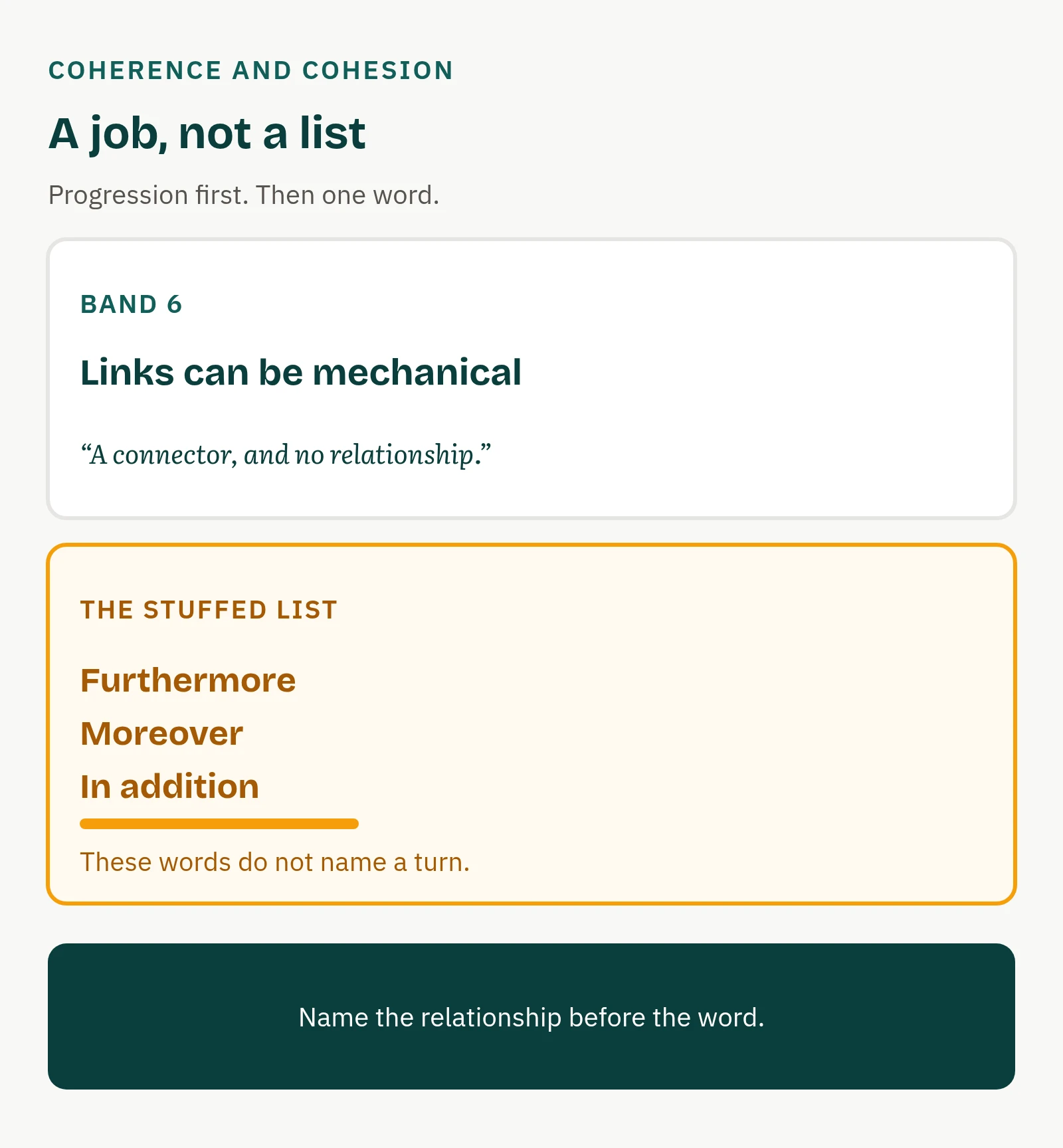
Name the relationship, then the word
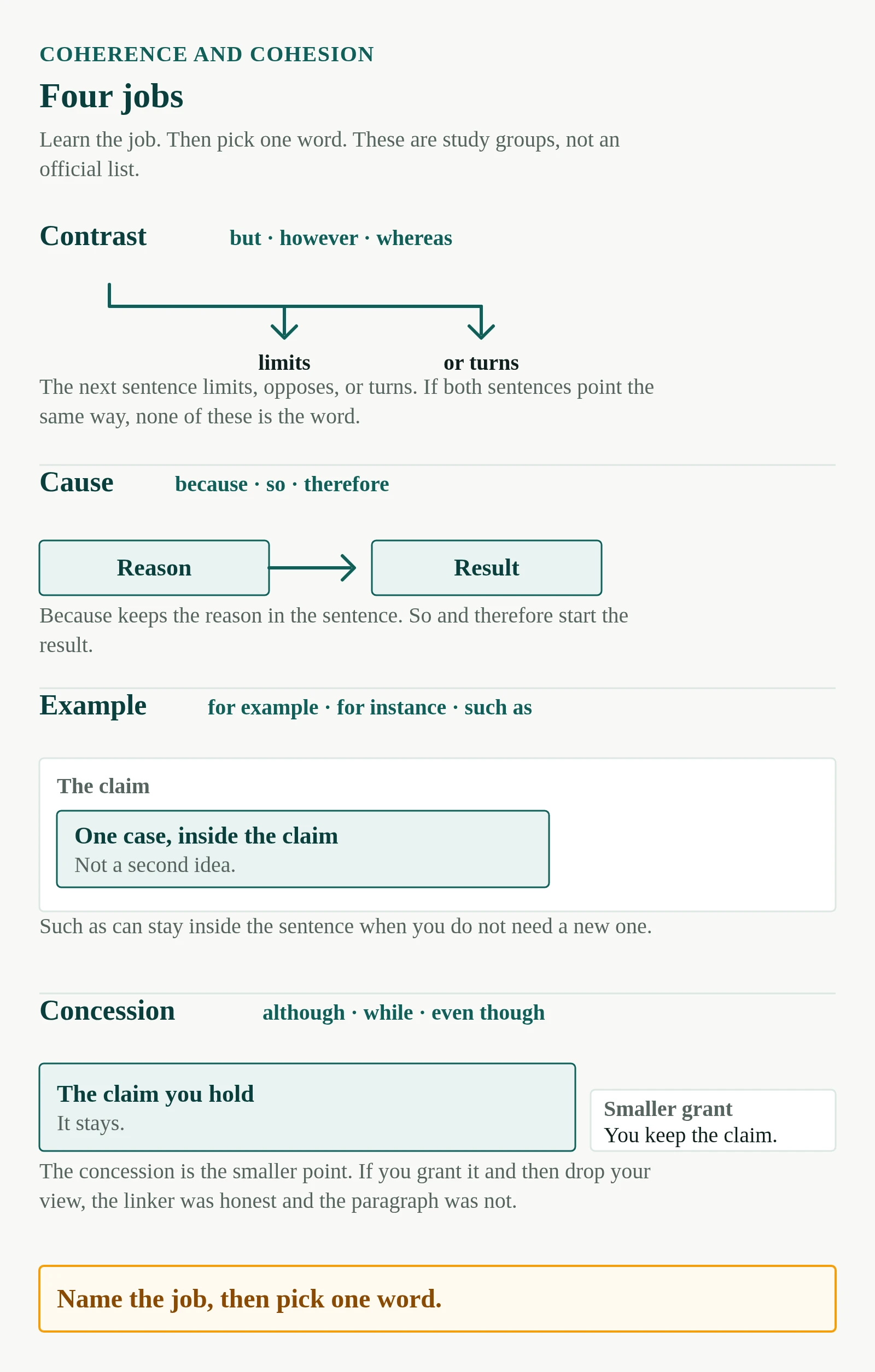
Four jobs cover most of the links a Task 2 body paragraph needs. These are study groups, not an official list, and not a catalogue to memorise. Each group has two or three words. Learn the job. Then pick one word.
Contrast. The next sentence limits, opposes, or turns. The words are but, however, and whereas. "However" belongs in front of a turn. It does not belong in front of a second reason that agrees with the first. "Whereas" sets two sides next to each other. If both sentences point the same way, none of these three is the right word.
Cause. The next sentence gives a reason, or it gives a result. The words are because, so, and therefore. "Because" keeps the reason in the same sentence. "So" and "therefore" start the result. If you cannot point at the reason, do not borrow therefore to sound formal. A formal word on an empty cause is still mechanical.
Example. The next sentence is a case of the claim, not a new claim. The words are for example, for instance, and such as. One case is enough. A second "for example" often starts a second idea, and the paragraph loses its job. "Such as" fits inside the sentence when you do not need a new sentence at all.
Concession. You grant a point, and you keep your claim. The words are although, while, and even though. The concession is the smaller point. The claim you hold comes with it, not instead of it. "While" can do this job when the granted point is brief. If you grant the point and then drop your view, the linker was honest and the paragraph was not.
Addition is the job people over-mark. A second sentence in the same direction often needs no special word. "And" is enough, or a full stop. Furthermore, moreover, and in addition all pretend to be that job. They become a problem when the next sentence is actually a contrast, a cause, an example, or a concession. The word says "more of the same". The sentence does something else.
That mismatch is the mechanical "Furthermore" in How to move from 6.0 to 6.5 on IELTS Task 2. There, a limit was written as if it continued the claim. The fix was not a rarer connector. The fix was "while" or "but", because the relationship was a narrowing, not an addition. You do not need a fifth group, or a page of synonyms. "Firstly" and "in conclusion" can mark the shape of a whole essay. They do not repair a sentence that turns the wrong way.
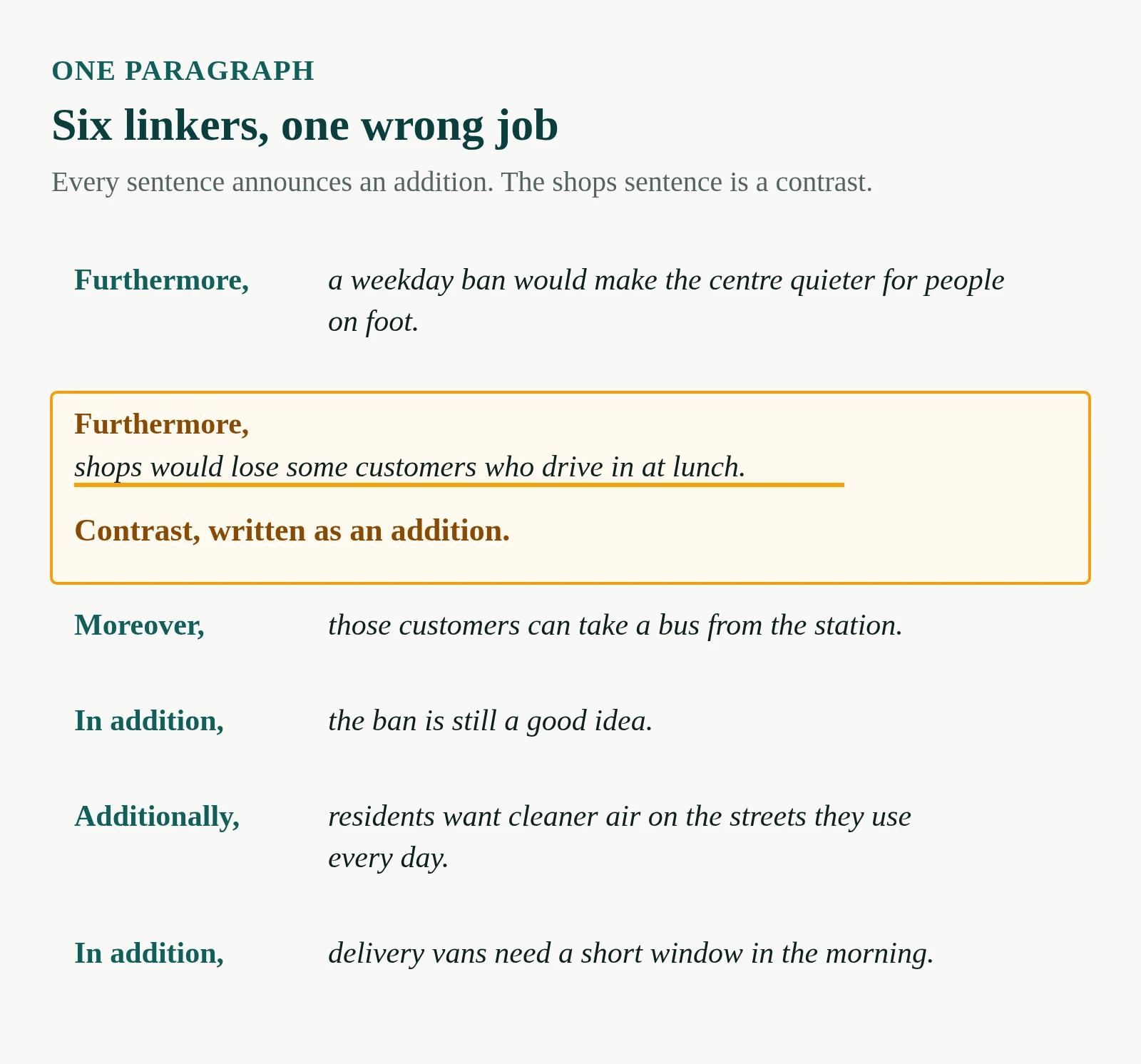
One invented paragraph, over-linked
Example. An original prompt, invented for this article, not an official question. More practice, grouped by subject, is on Task 2 topics.
Some people think city centres should be closed to private cars on weekdays. Others think cars should still be allowed. Discuss both views and give your own opinion.
That discuss-both shape is one of the Task 2 question types. The position for the paragraph below is also invented. Cars stay out of the centre on weekdays. Evenings stay open for residents who drive. This paragraph's job is the weekday closure, not the whole essay.
A linker on every sentence. Invented for this article:
Furthermore, a weekday ban would make the centre quieter for people on foot. Furthermore, shops would lose some customers who drive in at lunch. Moreover, those customers can take a bus from the station. In addition, the ban is still a good idea. Additionally, residents want cleaner air on the streets they use every day. In addition, delivery vans need a short window in the morning.
Six sentences. Six linkers. Every sentence announces itself, and none of the announcements is reliable.
The first "Furthermore" has nothing before it to add to. It is a pose. The second "Furthermore" is the leak to study. Losing customers is not more of the same as a quieter centre. It is a cost. The relationship is contrast. Furthermore is standing in front of that contrast, which is what a mechanical link looks like. The word and the sentence disagree.
"Moreover, those customers can take a bus" answers the cost. That is a reason the cost is smaller, or a concession that the cost exists and the ban can remain. It is not a third addition. "In addition, the ban is still a good idea" repeats the position. Delete the linker and the sentence says the same thing, so the linker had no job.
"Additionally" and the last "In addition" put two jobs under one empty word. Cleaner air is a cause. The morning window for vans is a concession. The grammar can be fine on every line. Coherence and Cohesion still reads as mechanical, because the links do not match. The labels are wrong.
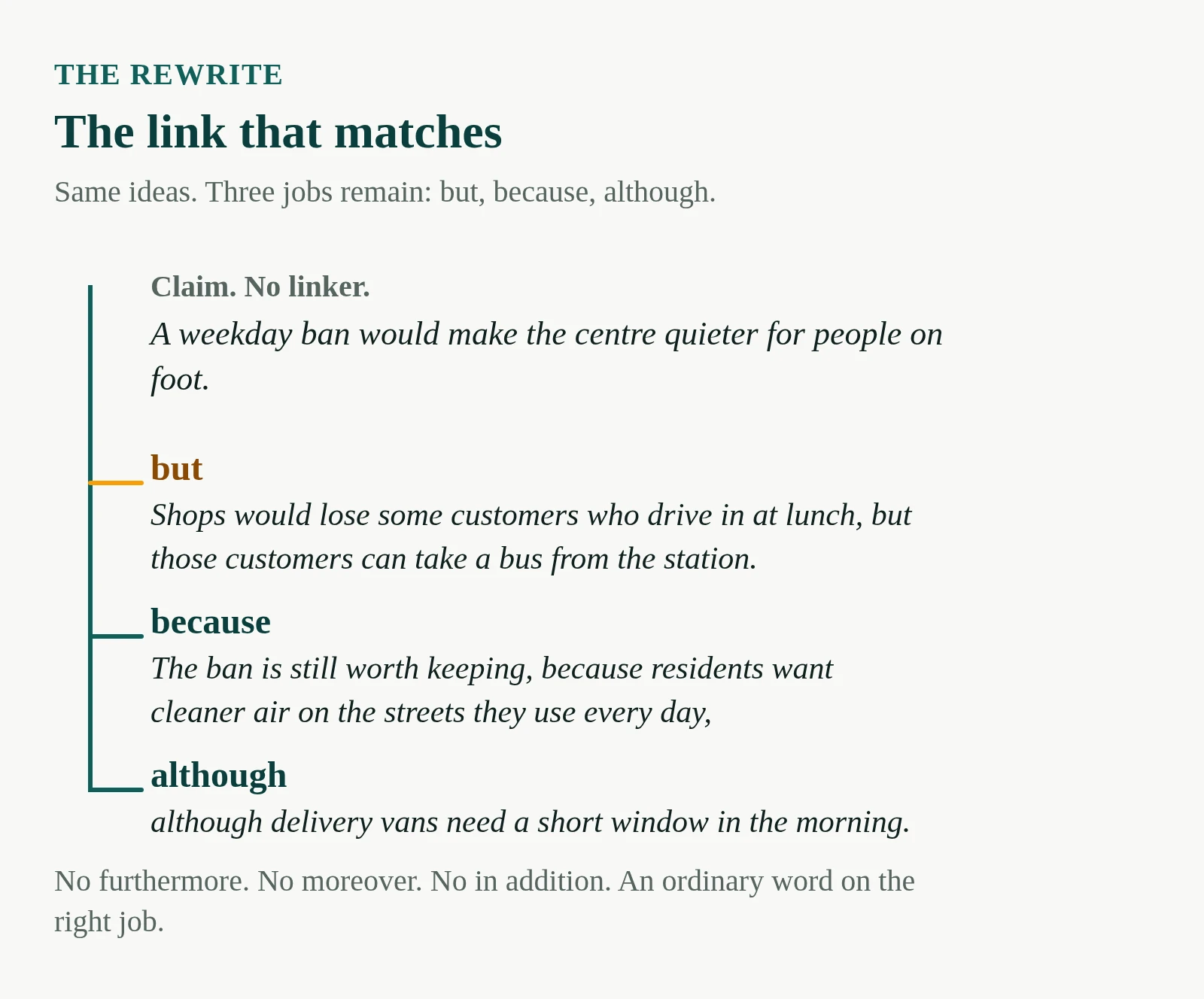
The same paragraph, rewritten
Same invented prompt. Same ideas. The linkers that remain mark a real relationship.
A weekday ban would make the centre quieter for people on foot. Shops would lose some customers who drive in at lunch, but those customers can take a bus from the station. The ban is still worth keeping, because residents want cleaner air on the streets they use every day, although delivery vans need a short window in the morning.
The first sentence has no linker. It is the claim. A claim does not need to announce itself.
"But" marks the contrast the old paragraph hid. Shops lose some drivers, and those drivers have another way in. The reader does not have to guess that the second clause answers the first. "However" could open a new sentence and do the same job.
"Because" marks the cause. Cleaner air is why the ban stays. The word is ordinary, and it is the right job. One cause-word is enough.
"Although" marks the concession. Vans need access, and the ban still holds. The smaller point stays smaller. "While" or "even though" could carry the same grant. Pick one.
Three linkers remain: but, because, although. Three jobs, from three of the groups above. No furthermore. No moreover. No in addition. A rare word on the wrong job is still mechanical. An ordinary word on the right job is the flexibility the Band 7 line describes. Slightly under-used would be this paragraph with the van clause as its own short sentence and no new connector. That can still be clear. Six openers cannot.
How to practise this on the next essay
In the outline, next to each body sentence, write the job. Contrast, cause, example, or concession. If you cannot name one of the four, leave the linker out. A linker you cannot defend is the one to cut.
Keep one topic in the paragraph. If the next sentence needs a new topic, the fix is a new paragraph, or a cut, not a smoother connector. Moving from a mechanical link towards a clear progression is the same kind of single fix as the half-band step in How to move from 6.0 to 6.5 on IELTS Task 2. If the leak is Coherence and Cohesion, set down the false furthermore. Do not collect a new list of connectors.
Do not use the same word for two jobs. "However" can mark a cost. It should not also mark the reason you still hold the claim. If you are unsure, cut. You can add a linker when you can name the job.
Before you submit
Read the body once. About a minute. Mark each linker. Ask which relationship it names. If the answer is only "the next sentence", delete it. If the answer is contrast and the word is furthermore, change the word. Keep the links a stranger could defend.
Band7 is IELTS Writing Task 2 practice. Write the next essay on the Band7 Writing Desk, then read the Grade Report for that sitting. If the comments on Coherence and Cohesion quote a mechanical link, put one fix in the next outline: the relationship, then the word. The figure on that report is an Estimated Band, a practice figure, not an official result and not a forecast.
To see the links in an essay you have already written, paste it into the Task 2 checker.
Related posts
- What to expect from an AI IELTS Task 2 practice checker
What an AI IELTS Task 2 practice checker can honestly tell you, what it cannot, and how to use its feedback between timed essays.
- How to move from 6.0 to 6.5 on IELTS Task 2
Move an IELTS Task 2 essay from around 6.0 towards 6.5 by lifting one criterion at a time, using the public descriptors for 6 and 7.
- How to plan an IELTS Writing Task 2 essay
A paragraph-level outline for IELTS Writing Task 2 in about 40 minutes: what each paragraph must do before you write, with a worked example.
Browse every post on the Blog, or read the FAQ on Estimated Bands.
Write on the Writing Desk
Free accounts get 2 Grade Reports every calendar month, with Coach tools included.