What to expect from an AI IELTS Task 2 practice checker
You are choosing how to check a Task 2 essay: a generic chat such as ChatGPT, or a dedicated Task 2 practice checker. The useful question is not which tool tops a list. It is what an AI checker can honestly tell you about the essay you just wrote.
Use this article as a buying criterion. The checker on this site is Band7's IELTS Writing Task 2 checker, and it covers Task 2 only. If you want the method behind its figures, read How Estimated Band works.
A Task 2 sitting is one essay, about 40 minutes, at least 250 words. In the Writing score, Task 2 is worth twice as much as Task 1. The four public criteria are equally weighted, and bands are reported in whole and half bands. A practice checker is useful when it reads that same paper, on those same four criteria, and tells you what to change before the next sitting.
What a practice checker actually does
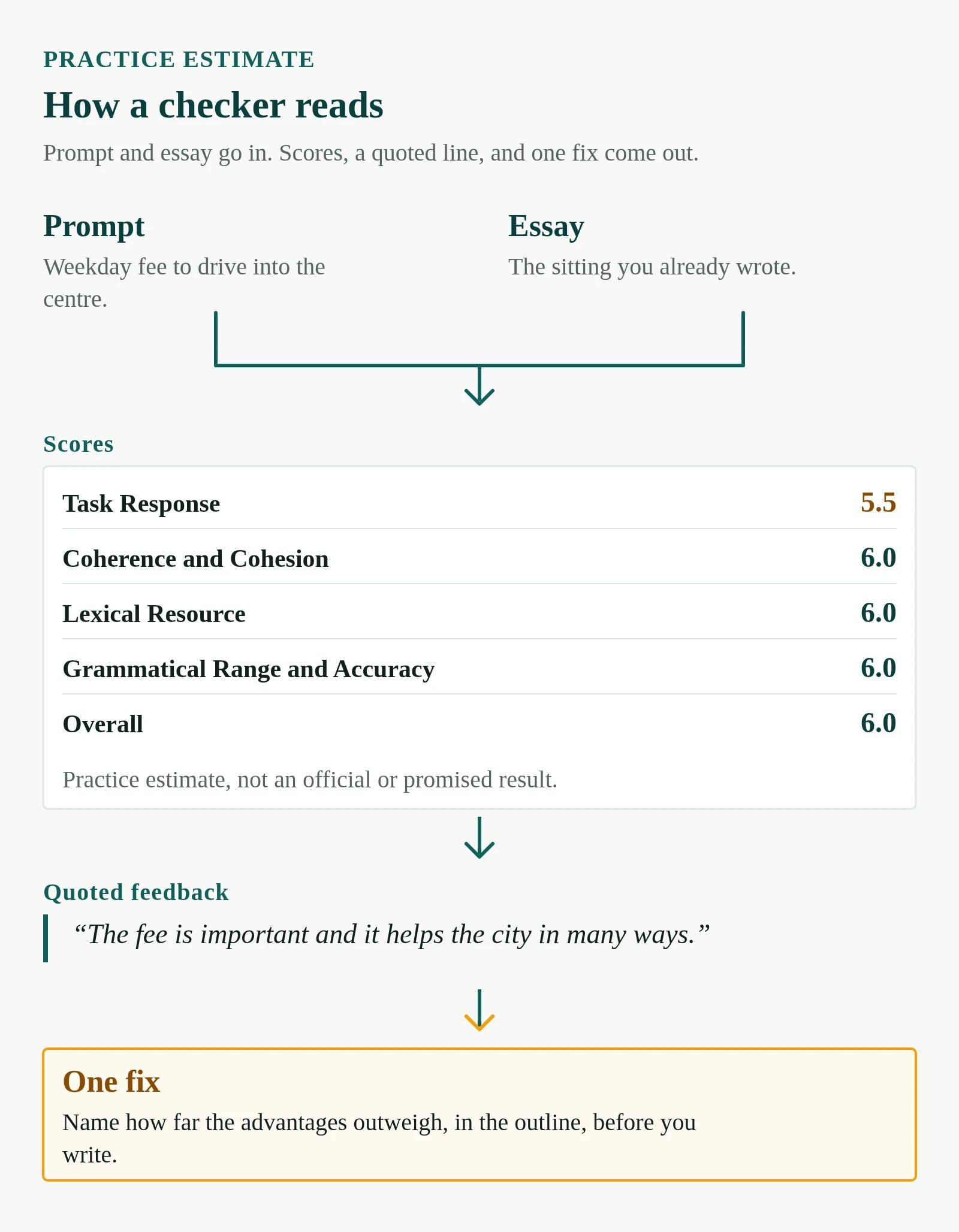
A dedicated Task 2 practice checker reads an essay you already wrote. You give it the prompt — the Task 2 question on the page — and the essay body. Pick a prompt from Task 2 topics when you need one. It returns a Grade Report: an Overall figure and a figure for each of the four criteria, plus Examiner Feedback that quotes sentences from that sitting.
The figures are Estimated Bands: practice figures in 0.5 steps. They help you choose what to study next.
The comments are the valuable part. They should name which criterion held the essay back, quote the evidence, and point to one change in the next outline — the paragraph-level plan you keep beside the essay, not the essay itself.
Generic chat will also give you a number if you ask for one. A dedicated checker is narrower on purpose: Task 2 only, the same four criteria every time, and the same report layout, so one sitting can be compared with the next.
On Band7 that reading happens after you write on the Writing Desk. Coach is the mode with in-writing help on; Mock is the mode with in-writing AI off and a timer running. Submit after the sitting. Do not pause the clock to ask the checker how the paragraph is going.
The four criteria it should read against
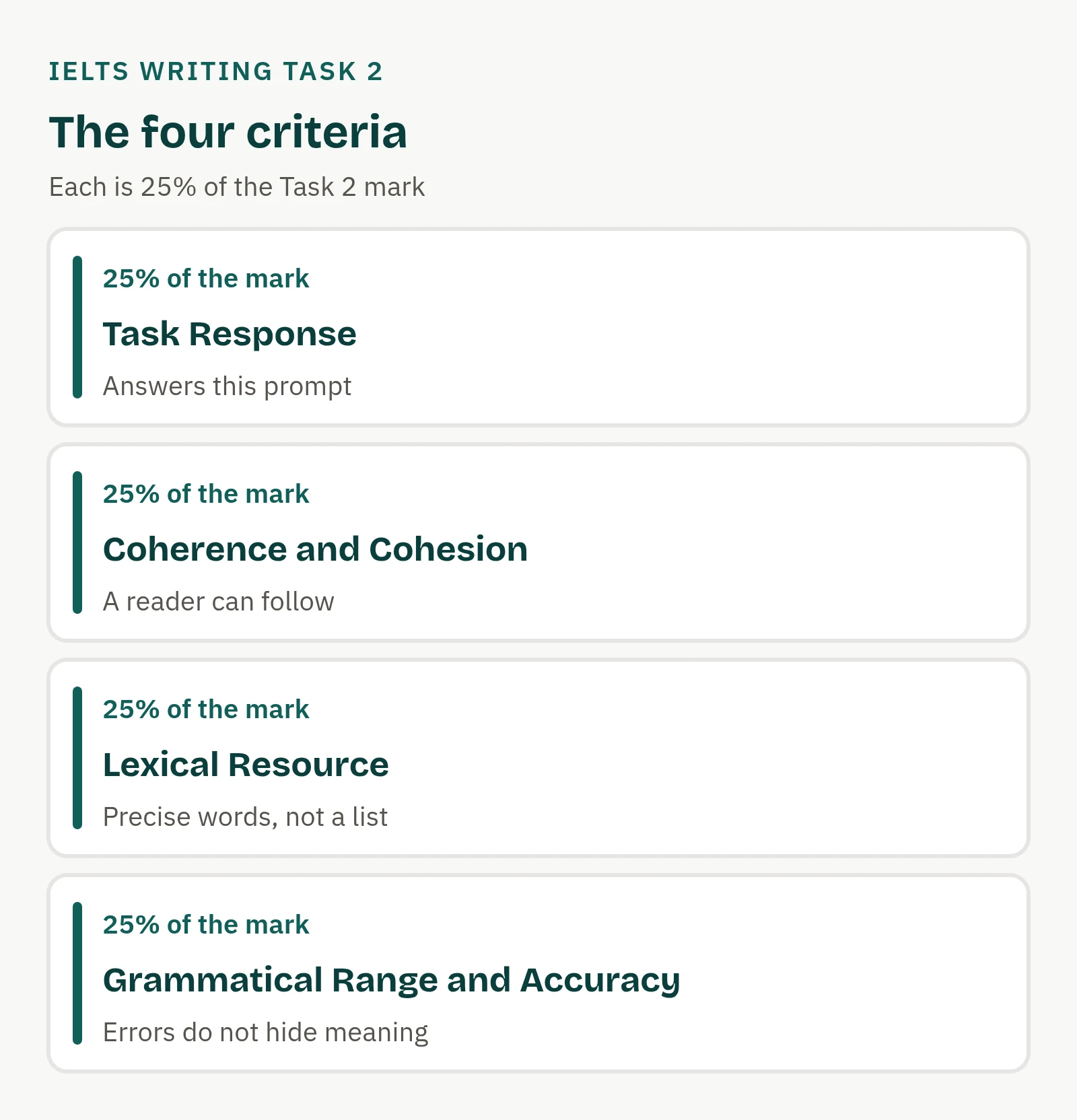
IELTS Writing Task 2 is assessed on four public criteria set out in the key assessment criteria PDF. Each criterion is 25% of the Task 2 mark. A checker that names only an Overall figure, or that invents its own labels, is harder to use between sittings. The public names, and a plain-English explainer, are on IELTS Writing band descriptors.
Task Response is whether the essay answers this prompt. A reader should find a view that belongs to the question, and ideas that support it. If the prompt asks “to what extent,” a yes or no without a degree is still a missing part. The usual leaks are a delayed position, a part of the question with no paragraph job, and an idea that is named and then left thin. For a closer diagnosis, read Task Response in IELTS Task 2.
Coherence and Cohesion is whether the writing is arranged so a reader can follow. Each paragraph should do a job. Sentences should connect. A pile of remarks that do not lead anywhere fails this criterion even when the vocabulary looks tidy.
Lexical Resource is the words on the page: how precise they are, how much range they show, and whether topic vocabulary belongs in the sentence rather than a memorised list dropped in. Repeating “important” for three different ideas is a typical leak.
Grammatical Range and Accuracy is whether you can vary how sentences are built, and how often grammar mistakes get in the way of meaning. Range without control is not the goal; the reader should not have to re-parse a sentence to find the position you already chose.
A checker should return an Estimated Band on each of these four, not a single unexplained number. Then you can see which criterion is weakest on this sitting, and only that criterion has to change in the next outline.
What useful feedback looks like
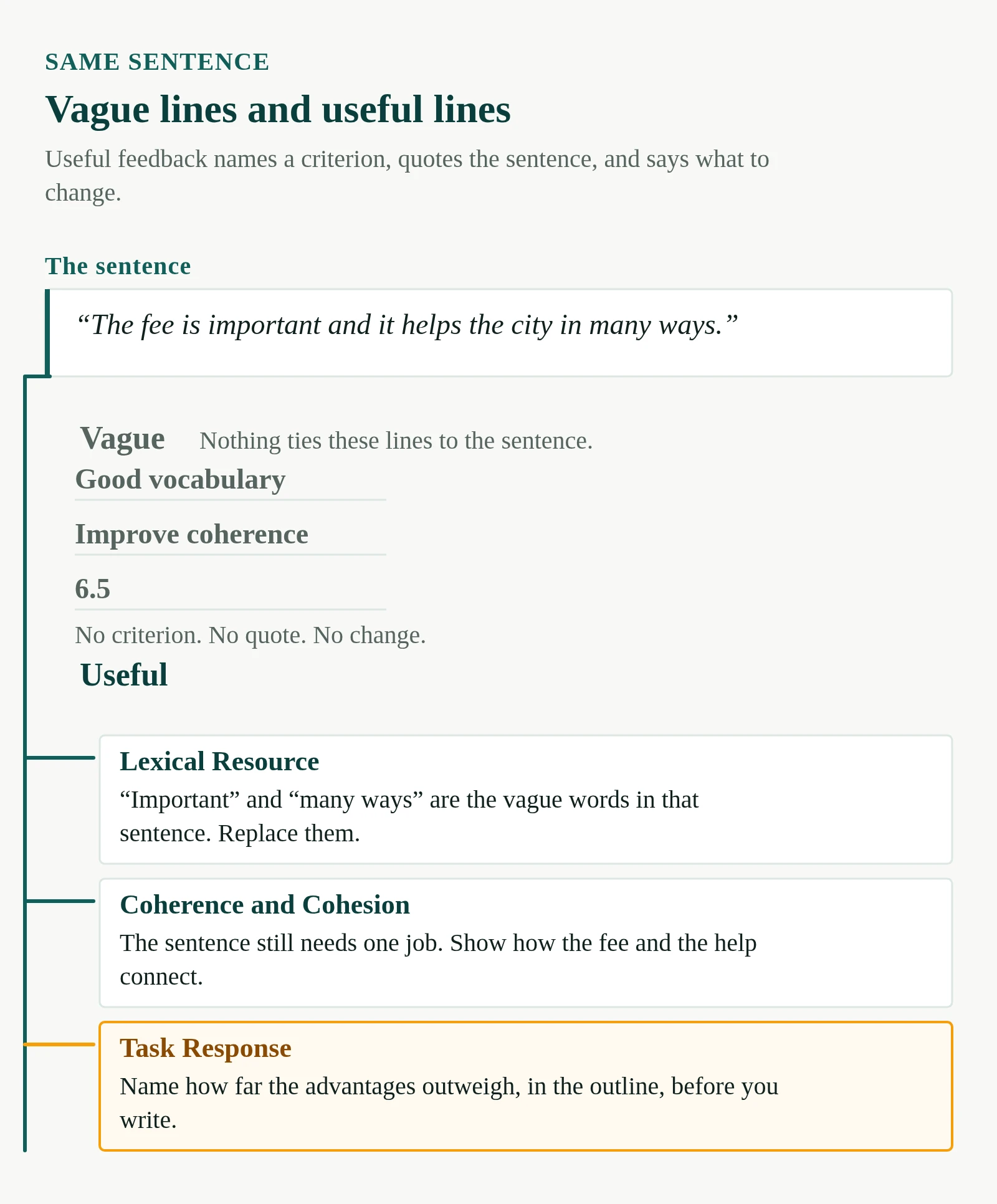
A number without a criterion, a quote, or a next step is not feedback you can take into the next outline. “Good vocabulary,” “improve coherence,” and a lone 6.5 all fail the same test: they do not name a criterion, quote a sentence, or say what to change.
Useful Examiner Feedback is narrower. It names a criterion, quotes a sentence you wrote, and says what to change. One sitting should produce one priority, not a rewrite of the whole essay.
Example. Two requests after the same original prompt (invented for this article, not an official question). Outweigh shapes are under Task 2 question types:
Some cities charge a fee to drive into the centre on weekdays. Do the advantages outweigh the disadvantages?
A generic chat asked “what band is this?” may return a single number with no Task 2 scope and no note on how the figure was made.
A dedicated Task 2 practice checker should return a Grade Report on this sitting: Overall and four criteria as practice figures, the reason behind each one, and a quoted line such as “The fee is important and it helps the city in many ways.” The useful follow-up is not a longer synonym list. It is: name how far the advantages outweigh, in the outline, before you write.
If Task Response is the weakest criterion, the next outline must hold the judgement. If Coherence and Cohesion is weakest, each body paragraph needs one job. If Lexical Resource is weakest, replace the vague word in the sentences you already planned. Do not collect three new fixes and apply them all at once.
What you should not expect
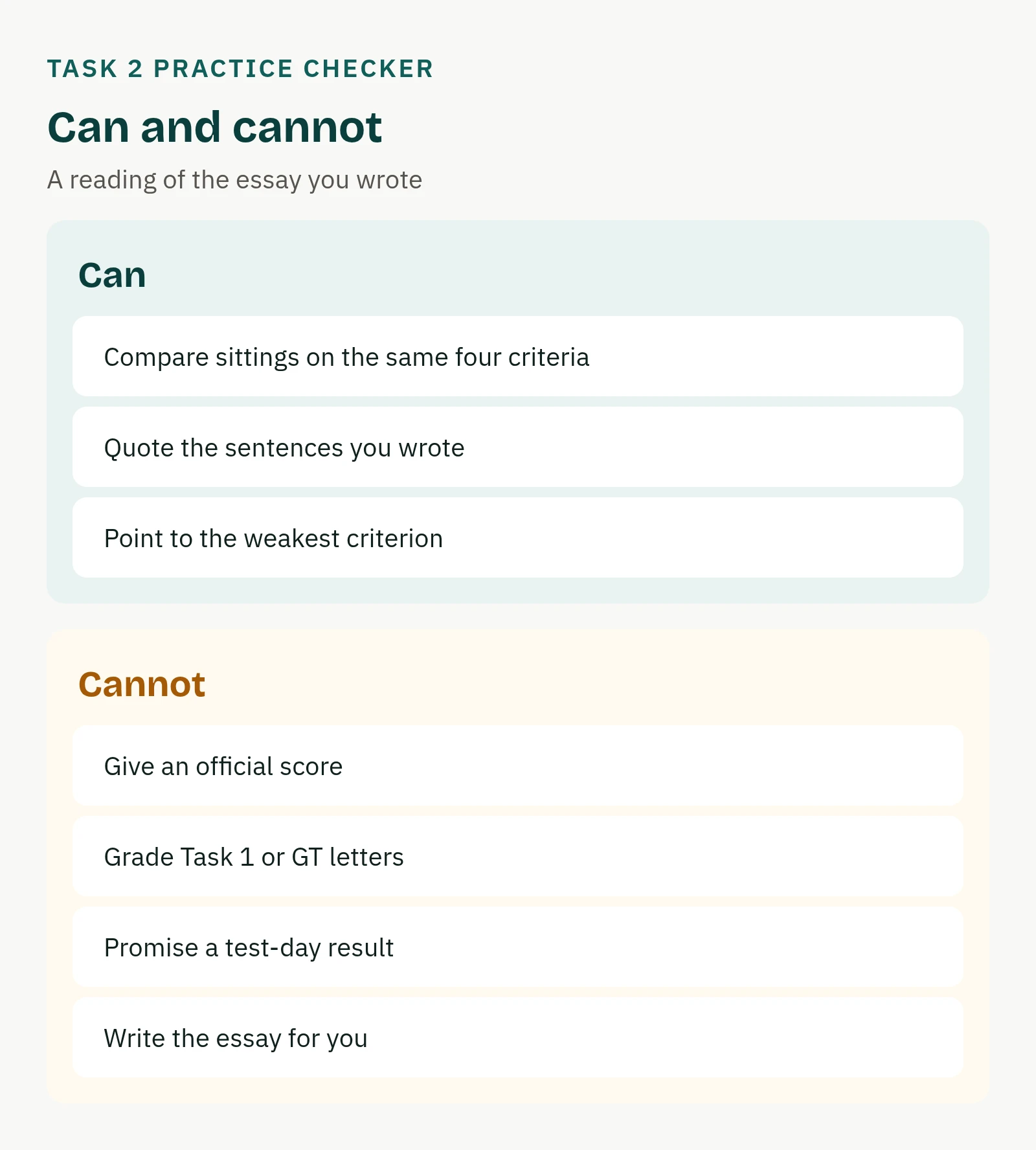
An official result. Admissions, visas and the test itself use the official IELTS result. A practice figure helps you decide what to study next.
Task 1 or General Training letters. Charts, graphs and letters are a different paper. An honest Task 2 checker does not pretend to grade them. Band7 covers Task 2 only.
A winner. Tools differ in scope and style, and a league table rarely tells you which one fits your practice. Judge a checker by what it says about your own essay.
Essays to copy. A practice checker comments on the essay you wrote. It should not hand you a finished Task 2 essay. A Learning Rewrite — a suggested change to a span you already wrote, applied only after you confirm — is a different tool from a finished essay you did not write.
A promised score. No checker can tell you what you will receive on the day. Use the Grade Report to pick the next outline, not to forecast the test.
Those limits are also a filter when you try a tool. If it offers a certificate, a Task 1 figure, a ranked list of products, or a finished essay to paste, it is selling something other than a reading of the sitting you wrote.
How to judge any checker in five minutes
Open a sitting you already wrote, or a short original paragraph on an invented prompt, and run this list.
Scope is stated. The tool says it is for Task 2, or it says what else it covers. If it is silent, treat the figure as unscoped.
The four criteria are named. Task Response, Coherence and Cohesion, Lexical Resource, Grammatical Range and Accuracy. Same names as the public descriptors.
Evidence quotes appear. Feedback that never quotes your sentences is commentary on a generic essay.
The estimate is labelled. Overall and criterion figures should be marked as practice estimates, in whole and half bands.
The layout is consistent. Two sittings should produce reports you can put side by side. If the labels change every time, you cannot compare.
Privacy is stated. You should be able to find what happens to the essay you paste. If that is missing, ask before you put a full sitting into a generic chat.
It does not replace the essay. Comments on what you wrote are useful. A finished essay in a different voice is not practice.
If you want a dedicated Task 2 product with a stated free grant of Grade Reports, see Pricing.
How to use it between timed essays
Timed rehearsal is a separate skill: How to practise IELTS Task 2 under timed conditions. Write first, then check. A checker used while you write turns a rehearsal into an editing session.
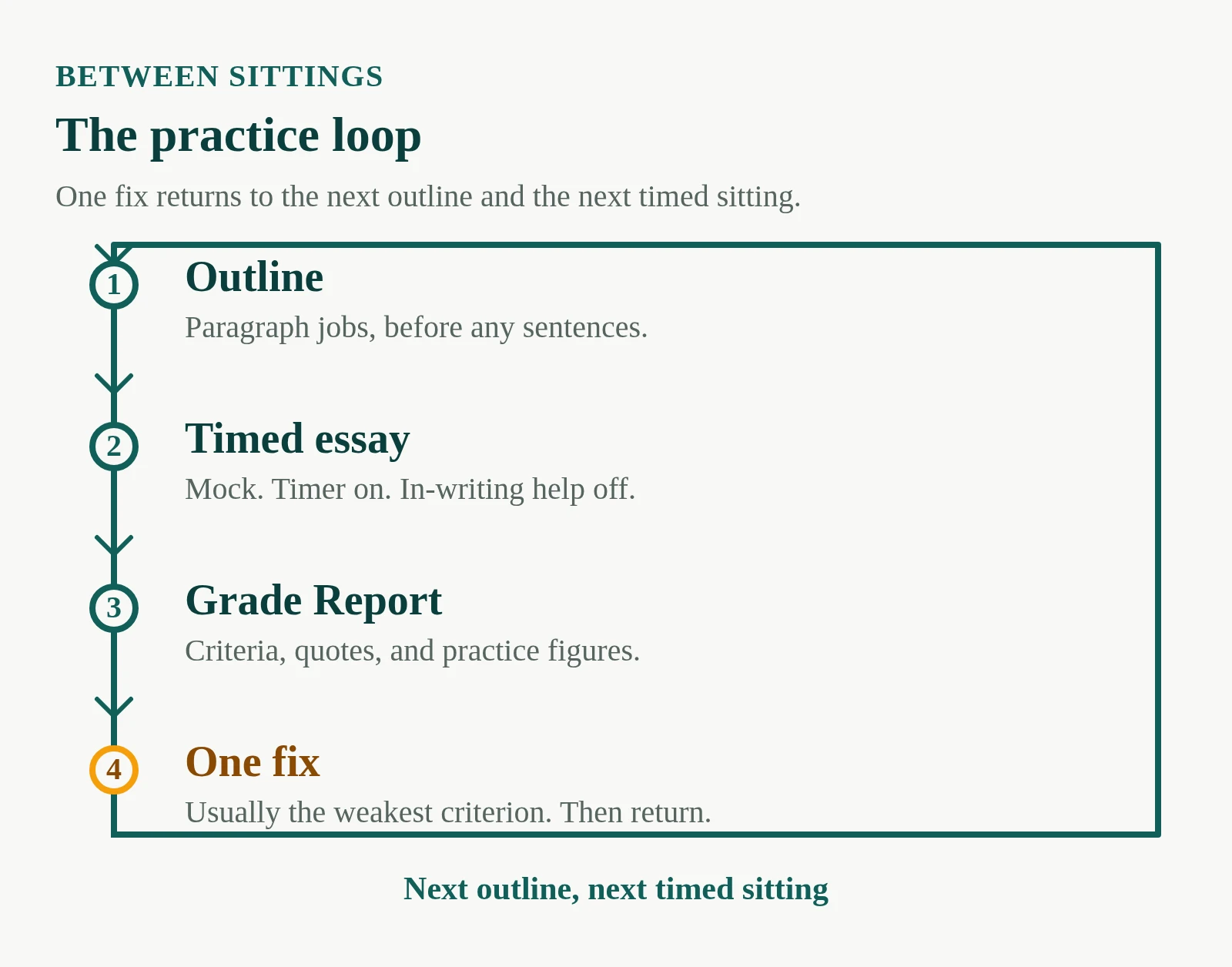
The loop is short. Build a paragraph-level outline — How to plan an IELTS Writing Task 2 essay is the method. Write the sitting in Mock: timer on, in-writing AI off. Submit for a Grade Report. Choose one fix, usually the weakest criterion. Put that fix into the next outline and write again.
One fix per sitting is slower than a rewrite of everything, and it is the only way the next report can tell you whether the change landed. Compare several Grade Reports, not one. A single Overall figure moves around; a criterion that is weakest three times in a row is the work.
Cross-check the comments with the public descriptors on IELTS Writing band descriptors. If your practice sits around 6.0 towards 6.5, How to move from 6.0 to 6.5 on IELTS Task 2 is the band-goal companion to this loop.
When a human teacher still helps
A checker is a consistent reader of the essay you finished. A teacher who works from the public descriptors can still help when the sitting is odd: a prompt with two parts you only half-answered, a position you thought you had stated, or a report you disagree with. Use the Grade Report as the agenda for that conversation, not as a replacement for it.
Choose the product, then write
If you want a dedicated Task 2 practice checker, open Band7 and write on the Writing Desk. Use each Grade Report to decide what the next outline and the next timed sitting must fix.
Related posts
- How to move from 6.0 to 6.5 on IELTS Task 2
Move an IELTS Task 2 essay from around 6.0 towards 6.5 by lifting one criterion at a time, using the public descriptors for 6 and 7.
- How to plan an IELTS Writing Task 2 essay
A paragraph-level outline for IELTS Writing Task 2 in about 40 minutes: what each paragraph must do before you write, with a worked example.
- How to practise IELTS Task 2 under timed conditions
A suggested 40-minute Task 2 rehearsal: plan, write, and check with the timer on, then read the Grade Report after you stop.
Browse every post on the Blog, or read the FAQ on Estimated Bands.
Write on the Writing Desk
Free accounts get 2 Grade Reports every calendar month, with Coach tools included.