How to move from 6.0 to 6.5 on IELTS Task 2
A common IELTS Writing Task 2 goal is to move practice from around 6.0 towards 6.5. The half band is not a new essay shape. It is control where the 6 descriptor still leaks.
6.5 is a half band. The public descriptors describe whole bands, including 6 and 7. There is no column for 6.5, and no published formula that turns marks for the four criteria into that half band. Moving towards 6.5 means features from the 7 descriptor show on at least some criteria, while others may still read as 6. Revise one criterion. Do not invent a rounding rule.
What changes between the 6 and 7 descriptors
Set aside about 40 minutes, and write at least 250 words. In the Writing score, Task 2 is worth twice Task 1. The four criteria are equally weighted, and bands are reported in whole and half bands.
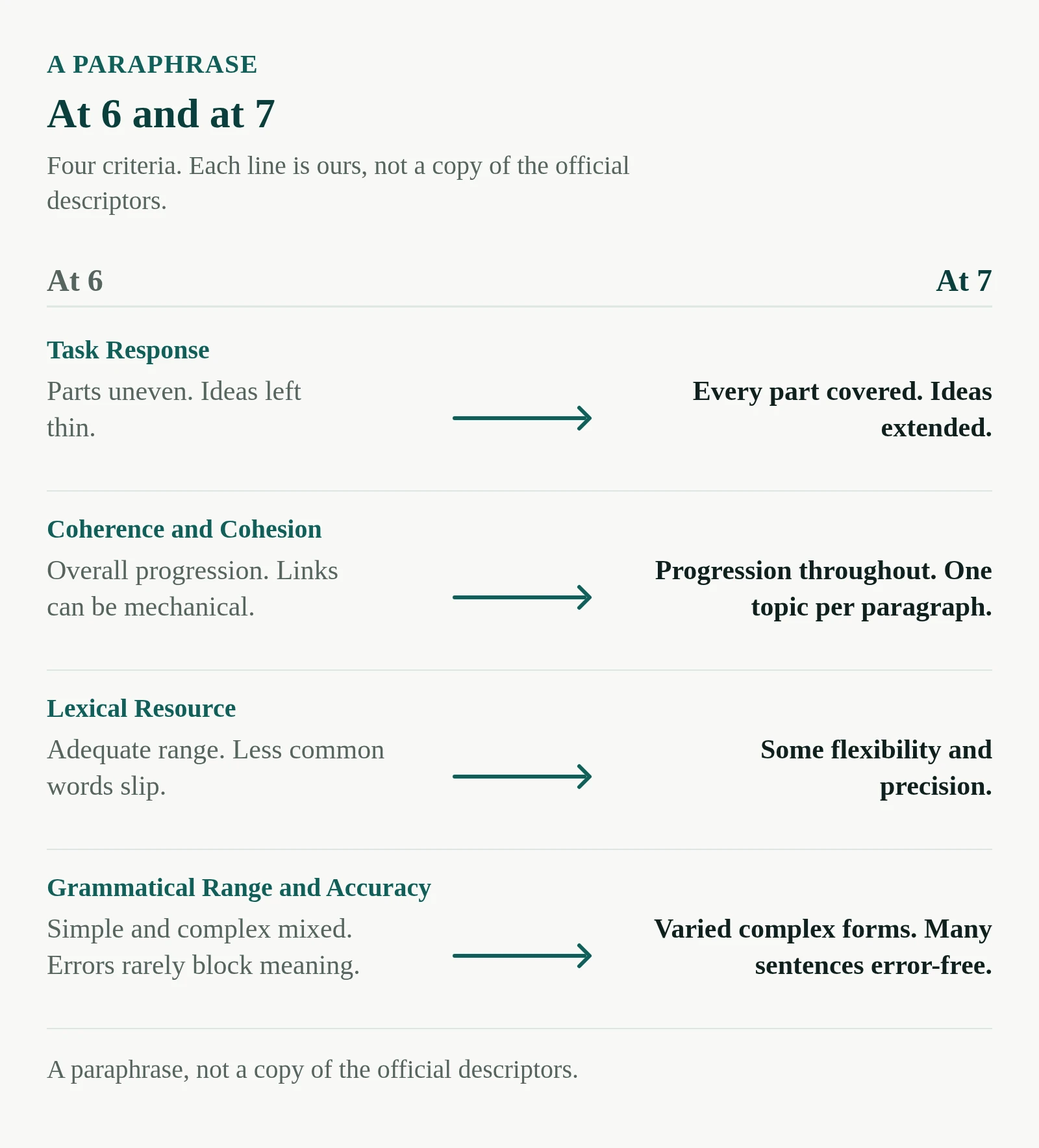
The four criteria are Task Response, Coherence and Cohesion, Lexical Resource, and Grammatical Range and Accuracy. The plain explainer is IELTS Writing band descriptors, and the official wording is in the Writing Band Descriptors PDF. The pairs below are a paraphrase, not a score key.
Task Response answers this prompt. At 6, parts uneven, ideas left thin: some parts are fuller than others, the conclusion may blur, and some ideas stay under-developed. At 7, every part covered, ideas extended: the position stays clear, ideas are extended and supported, and they may still over-generalise.
Coherence and Cohesion is whether a reader can follow. At 6, overall progression, links can be mechanical: paragraphing is not always logical, links can be faulty, and “this” can be unclear. At 7, progression throughout, one topic per paragraph: each paragraph has one central topic. Links may be slightly over-used or under-used.
Lexical Resource is range and precision. At 6, adequate range, less common words slip: less common words are sometimes inaccurate. Spelling or word-formation errors do not block communication. At 7, some flexibility and precision: there is some feel for style and for words that sit together. An occasional error of choice or form can remain.
Grammatical Range and Accuracy is sentence building. At 6, simple and complex mixed, errors rarely block meaning: both forms appear, and errors rarely stop the reader. At 7, varied complex forms, many sentences error-free: patterns are not all the same, and a few errors can remain.
Find the criterion that is holding the essay
Do not revise all four criteria in the next essay. A Grade Report is what you receive after you submit one essay: an Overall figure, a figure for each of the four criteria, and Examiner Feedback, comments that quote sentences from that sitting. The figures are Estimated Bands, practice figures in half-band steps, for choosing what to study. How they are produced is on How Estimated Band works.
Use the same order each time you open a report.
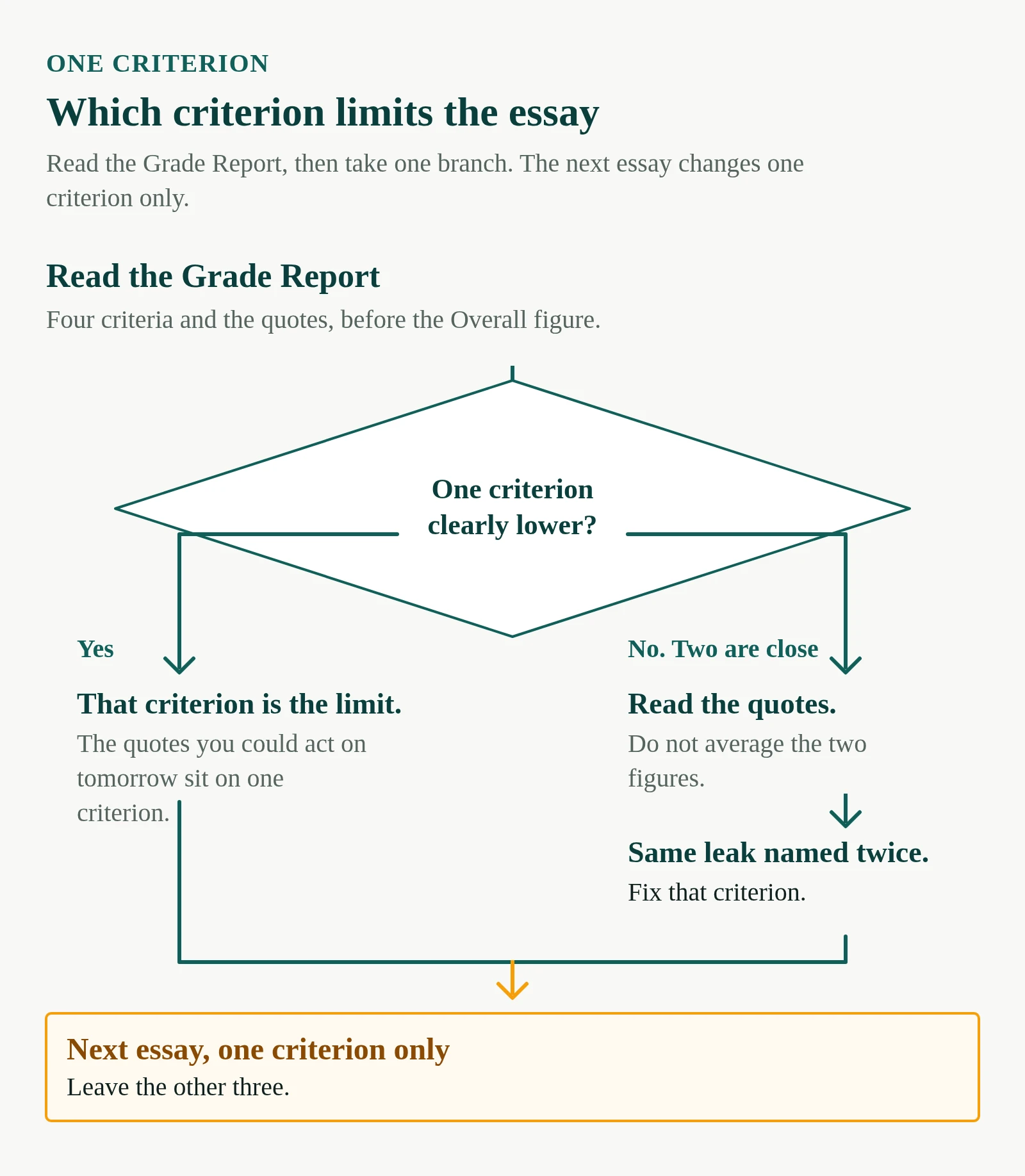
Read the Grade Report. Read the four criteria and the quotes before the Overall figure. The Overall figure only summarises the sitting. The quotes name the change.
One criterion clearly lower. That criterion is the limit. “Clearly lower” is not a private sum of the four figures. It means the quotes you could act on tomorrow sit on one criterion, and the other comments are single slips. If every criterion has one mild note and one criterion has three, that third pile is the limit. The next outline — the paragraph plan beside the essay, not the essay itself — changes only that criterion.
Two criteria close together. Read the quotes. Do not average the two figures, and do not pick the criterion you feel worst about.
Same leak named twice. Fix that criterion. On a libraries essay, two quotes that say you never named how far you agree are Task Response, even if one spelling is also marked. Match the quote to a line at 6 above if you want the public wording beside the comment. The next essay still changes one criterion.
Next essay, one criterion only. Leave the other three. Judge the essay you submitted. A paragraph rewritten after you have seen the report is a different piece of writing, and it will not tell you what limited the sitting. When the limit is Task Response, go on to Task Response in IELTS Task 2. One leak goes into the outline before any new sentences.
Hold the position, then extend one idea
Every part of the prompt has a paragraph job. Two parts of a question need two developments, not a sentence at the end. If it asks “to what extent,” a yes or no with no degree is still a missing part. The Task 2 question types pages name those parts for each shape.
The position is named early and held. The same extent is in the outline and in the last paragraph. At 6, the conclusion often blurs.
One idea is extended. Name the support in the outline, then write only that paragraph. Two reasons with no support leave the idea thin.
Example. An original prompt invented for this article, not an official question. More practice, grouped by subject, is on Task 2 topics. The opinion guide stays with agree/disagree and “to what extent”.
Local governments should spend more on public libraries than on sports centres. To what extent do you agree or disagree?
A common leak when practice is still around 6.0:
- The opening restates libraries versus sports centres and delays the extent of agreement.
- One body argues for libraries, the next for sports centres, and the conclusion never names a degree.
- Both sides appear. The position is not held.
Towards the 7 descriptor on this invented prompt:
- The outline names the extent first: agree more than disagree, because libraries serve more daily uses. Sports centres still matter, so the judgement is not “never fund sport”.
- Introduction: name the trade-off and the extent.
- Body 1: libraries reach more people, more often, so they take the larger share.
- Body 2: sports centres are worth funding as a smaller share, not the larger one.
- Conclusion: restate the same extent. Add no new claim.
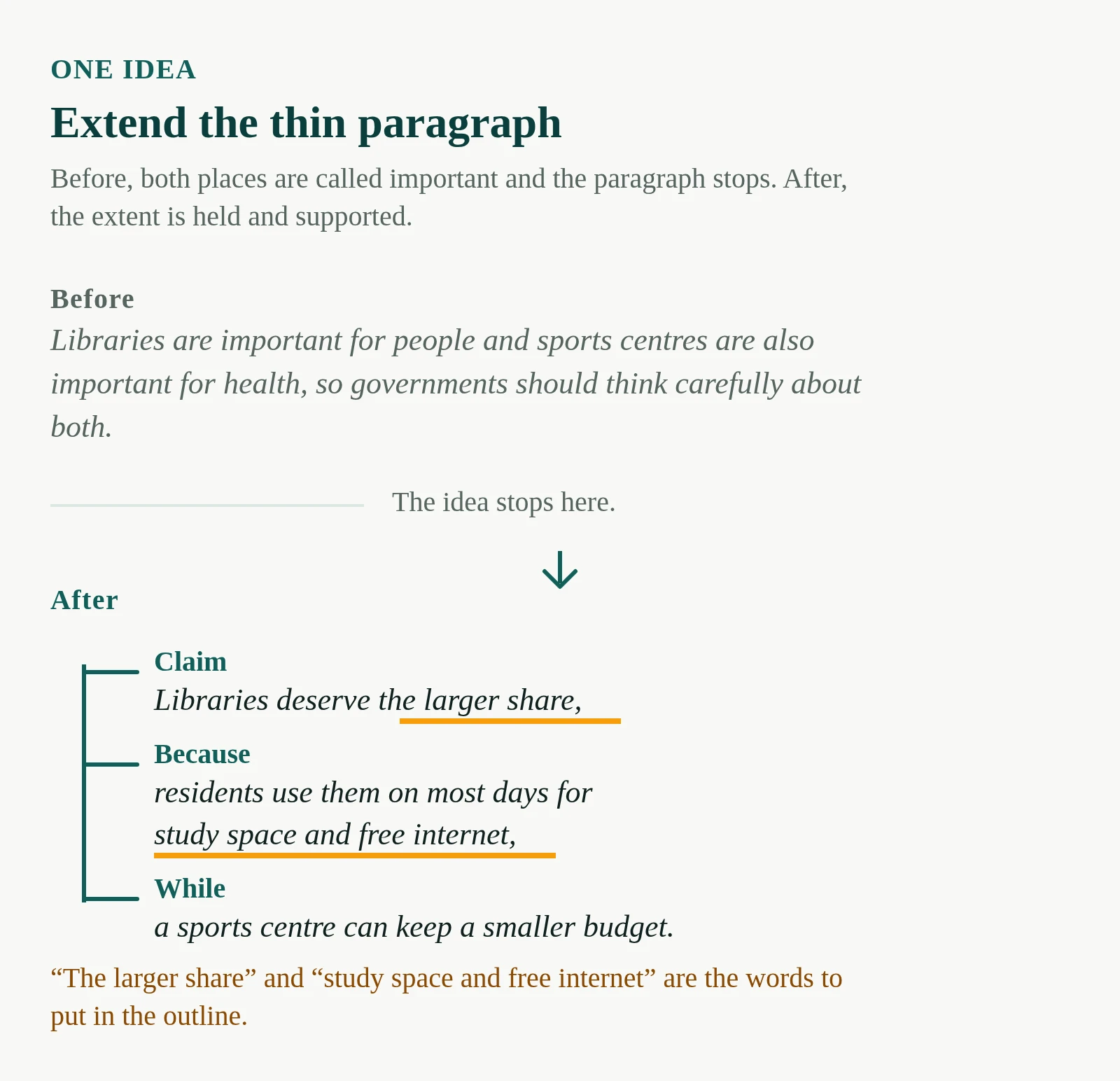
Before, the ideas are named and left thin:
Libraries are important for people and sports centres are also important for health, so governments should think carefully about both.
After, one idea is extended and the extent is held:
Libraries deserve the larger share, because residents use them on most days for study space and free internet, while a sports centre can keep a smaller budget.
Put “the larger share” and “study space and free internet” in the outline before you write. How to set paragraph jobs is How to plan an IELTS Writing Task 2 essay.
One topic, then one precise phrase
Coherence and Cohesion can stay at the 6 line after the position is clear. The essay has an overall progression, then a paragraph changes topic, or “Furthermore” stands in front of a contrast.
One topic per paragraph. In this outline, body 1 is only the daily use of libraries. Body 2 is only the smaller share for sports centres. A health sentence in body 1 moves to body 2, or it is cut. That is the step from overall progression to progression throughout, and to one topic per paragraph.
A link that matches. “Furthermore” before a limit is a mechanical link. If the next sentence narrows the claim, the relationship is “while” or “but”. You do not need a longer connector list. Linking words for IELTS Writing Task 2 groups the jobs those words do.
A “this” you can point at. “This” should mean the extent you just named. If the reader has to guess, the reference is unclear, which the 6 descriptor names as a leak, even when the grammar is tidy.
Read the paragraph once and underline its topic noun. A second topic noun with a new claim means the paragraph should split. Then stop. Cohesion work is not a second vocabulary draft.
Lexical Resource at 6 is often an adequate range plus a less common word that does not belong. The 7 line shows some flexibility and precision, with some feel for style and for words that sit together. “Paramount” does not repair a sentence that still means “important”. Change one vague wording on the same invented prompt.
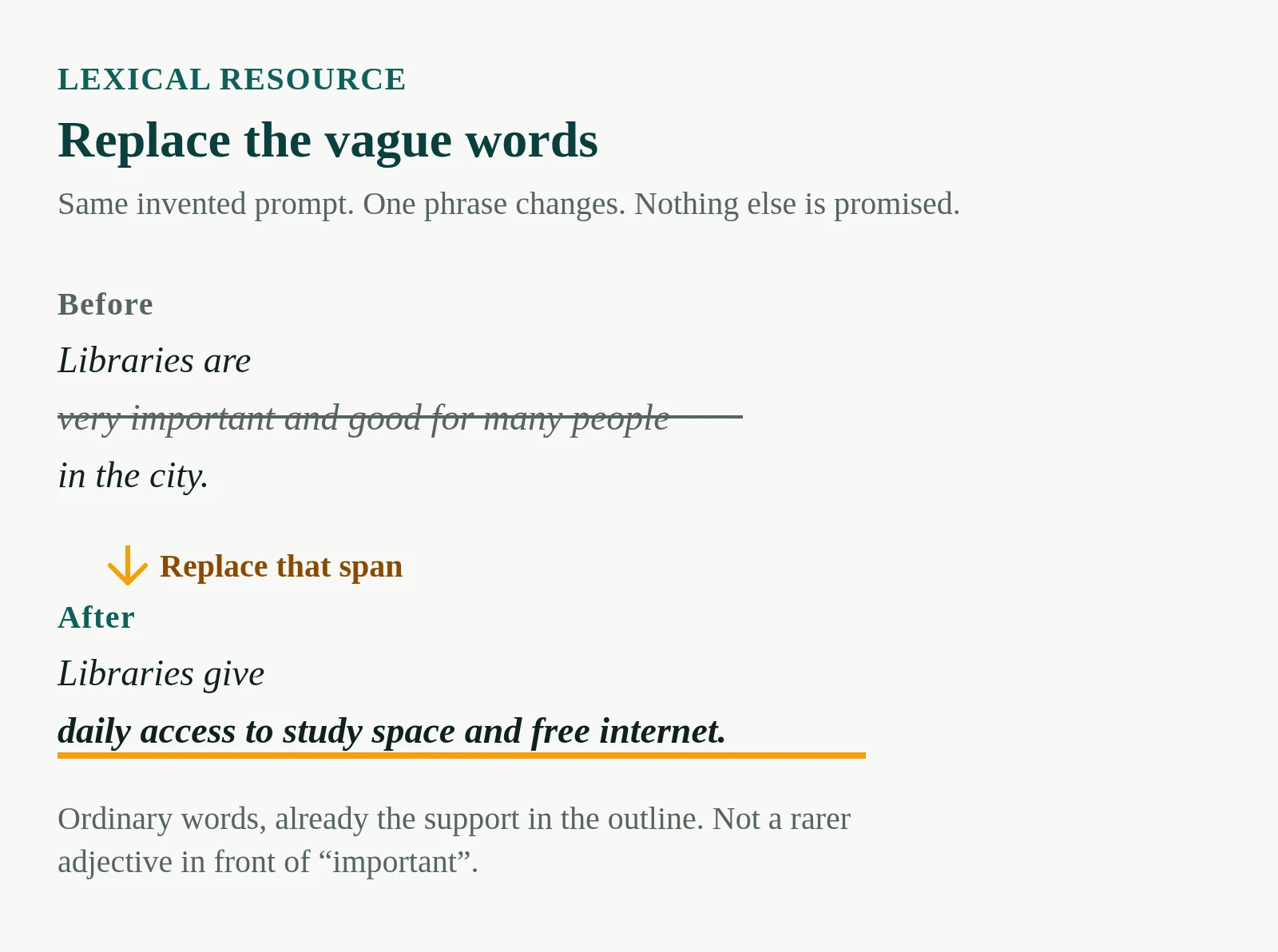
Before:
Libraries are very important and good for many people in the city.
After:
Libraries give daily access to study space and free internet.
“Daily access”, “study space”, and “free internet” are ordinary, and they are already the support in the outline. “Access” sits naturally with “daily”; a rarer adjective in front of “important” does not. One vague phrase per paragraph is enough for that sitting. If a less common word is wrong, put the plain word back.
One sentence, then several essays
At 6, writing already mixes simple and complex sentences, and errors rarely block meaning. For Grammatical Range and Accuracy, the 7 line is varied complex forms, with many sentences error-free, though a few errors can remain. Repair one sentence. Do not hide the extent under a new structure.
Before:
If government spend more to library, people will reading more and it is benefit.
After:
If local governments spent more on libraries, more residents would have a place to study.
Agreement, the preposition, and one conditional pattern are the repair. The larger share for libraries stays the meaning.
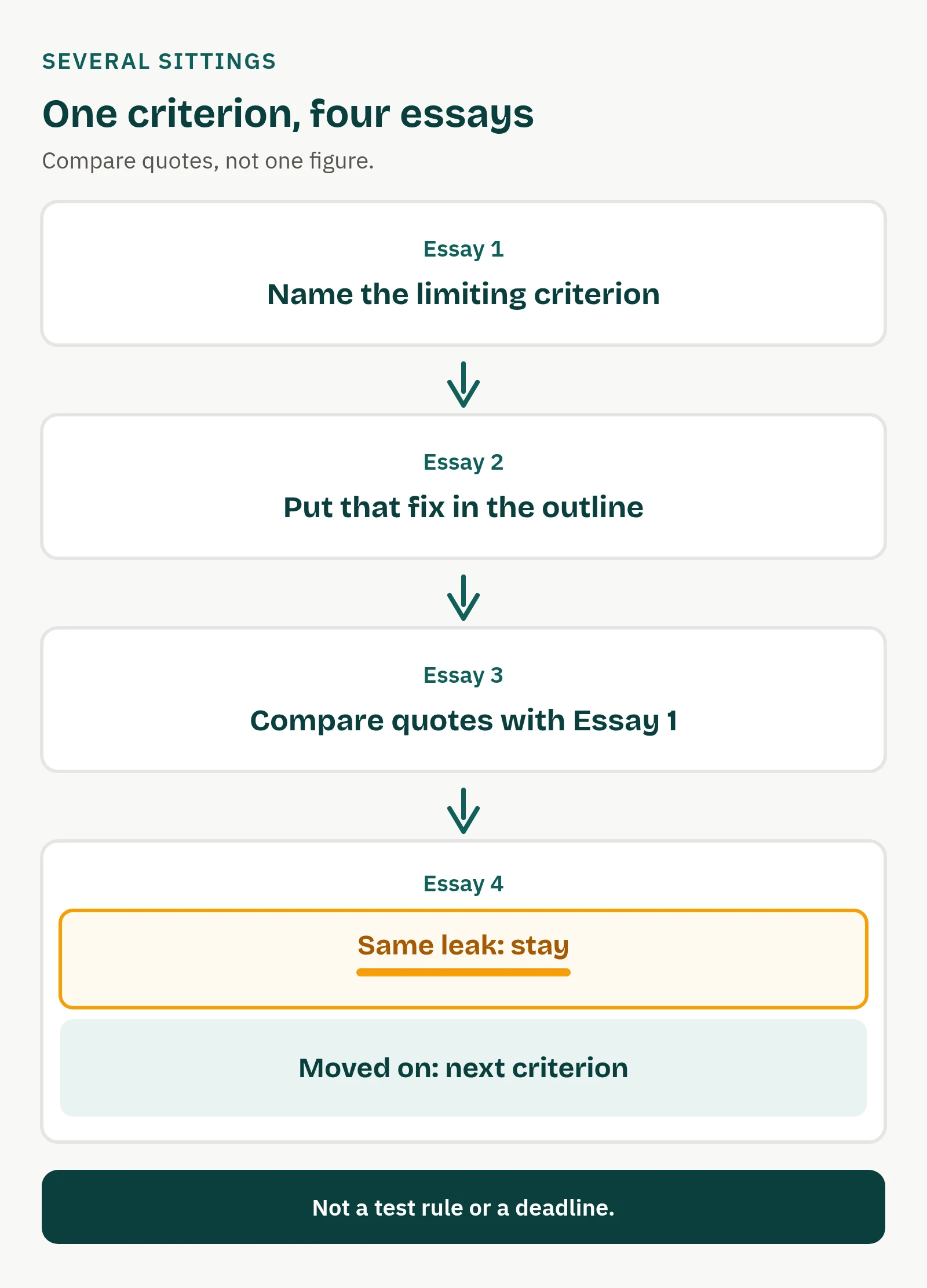
Compare Grade Reports on that criterion and ask whether the quotes changed. One Overall figure moves around, so leave it. Four sittings is a suggestion, not a test rule or a deadline.
Essay 1. Name the limiting criterion. Write under the clock, read the Grade Report, and note the criterion. Do not rewrite that essay.
Essay 2. Put that fix in the outline. Then write again. On Band7, use Mock: the timer runs, and in-writing AI is off. Leave Coach, where in-writing help stays on, for another pass. The clock is covered in How to practise IELTS Task 2 under timed conditions.
Essay 3. Compare quotes with Essay 1. If the same leak is still quoted, stay with that criterion.
Essay 4. Same leak: stay. Moved on: next criterion. If the quotes have left the leak, name the next criterion. If it is still quoted, stay. Two changes at once make the next report hard to read.
Descriptors do not date a half band. Some quotes shift in a few sittings, and some leaks take longer. An Estimated Band will not tell you the test day. Use a checker that quotes you and names one criterion: What to expect from an AI IELTS Task 2 practice checker. To find the limiting criterion in Essay 1, paste it into the Task 2 checker.
Aim at 6.5 from practice around 6.0. A goal of 7.0 needs the 7 line on more criteria, more often. Task 1 charts and General Training letters are a different paper.
Related posts
- How to plan an IELTS Writing Task 2 essay
A paragraph-level outline for IELTS Writing Task 2 in about 40 minutes: what each paragraph must do before you write, with a worked example.
- How to practise IELTS Task 2 under timed conditions
A suggested 40-minute Task 2 rehearsal: plan, write, and check with the timer on, then read the Grade Report after you stop.
- Task Response in IELTS Task 2
Task Response on IELTS Writing Task 2: cover every part, hold one position, and develop ideas before you submit.
Browse every post on the Blog, or read the FAQ on Estimated Bands.
Write on the Writing Desk
Free accounts get 2 Grade Reports every calendar month, with Coach tools included.