How to plan an IELTS Writing Task 2 essay
IELTS Writing Task 2 is one essay, in Academic and in General Training. The recommended time is about 40 minutes, and the task asks for at least 250 words. In the Writing score, Task 2 is worth twice as much as Task 1. The essay is assessed on four public criteria, equally weighted: Task Response, Coherence and Cohesion, Lexical Resource, and Grammatical Range and Accuracy. Those names are in the key assessment criteria. Bands are reported in whole and half bands. Plain-English notes are on IELTS Writing band descriptors.
The useful first minutes are not the opening sentence of the essay. They are a paragraph-level outline: the plan you keep beside the essay. The prompt is the Task 2 question on the page. The outline is not the essay.
Why the outline is a list of jobs
Task Response is whether the essay answers this prompt. Coherence and Cohesion starts when each paragraph has one job. Lexical Resource and Grammatical Range and Accuracy are decided in the sentences, after those jobs exist. The outline does not earn the last two criteria. It stops a tidy essay that misses the task.
A one-line sketch does not say what each paragraph is for. A script of full sentences is too slow, and it becomes the essay before you have a position. Write one job per paragraph, and the idea that will carry it.
Mark the prompt before you take a side
Read three marks, in this order.
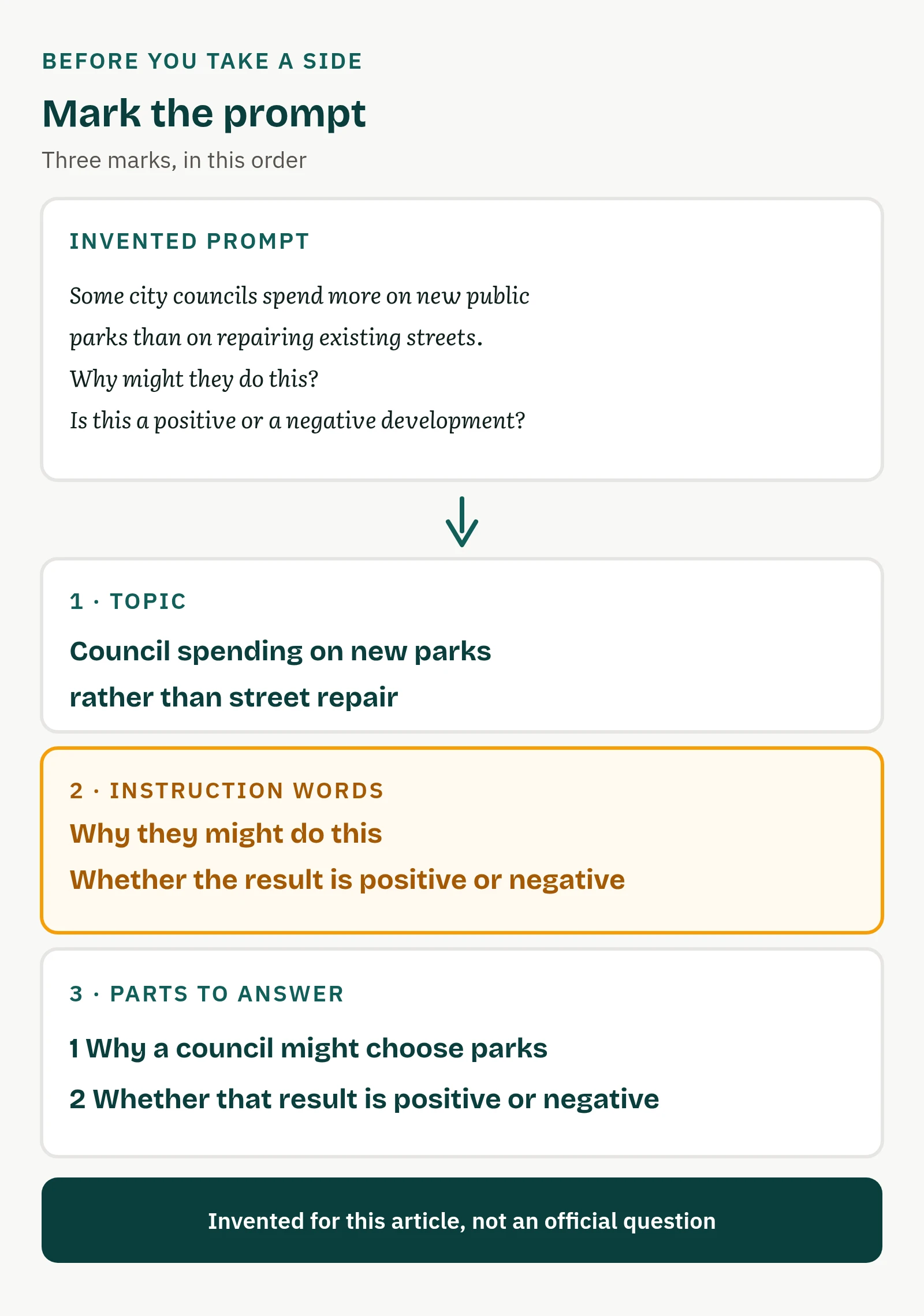
Topic. What this question is about. Notes that still fit a different question are a theme, not a topic. Those themes are collected on Task 2 topics.
Instruction words. What you must do: agree or disagree, discuss both views, weigh advantages, explain a cause, answer two questions, or judge a development.
Every part. Two questions means two parts. “To what extent” means a degree, not only yes or no. “Do the advantages outweigh the disadvantages?” means which side weighs more. “What are the advantages and disadvantages?” means both sides, not a winner you add.
Example. Invented for this article, not an official question:
Some city councils spend more on new public parks than on repairing existing streets. Why might they do this? Is this a positive or a negative development?
- Topic: council spending on new parks rather than street repair.
- Instruction words: why they might do this, and whether the result is positive or negative.
- Parts to answer: (1) why a council might choose parks; (2) whether that result is positive or negative.
Skip the “why”, or skip the judgement, and a part has no job.
Let the instruction words choose the jobs
A common shape is an introduction, two body paragraphs, and a conclusion. That is a starting point, not a form for every prompt. The five groups below are a practical sort for the first minutes, not an official list. Each one is written out on Task 2 question types. If a group cannot hold every part you marked, trust the parts.
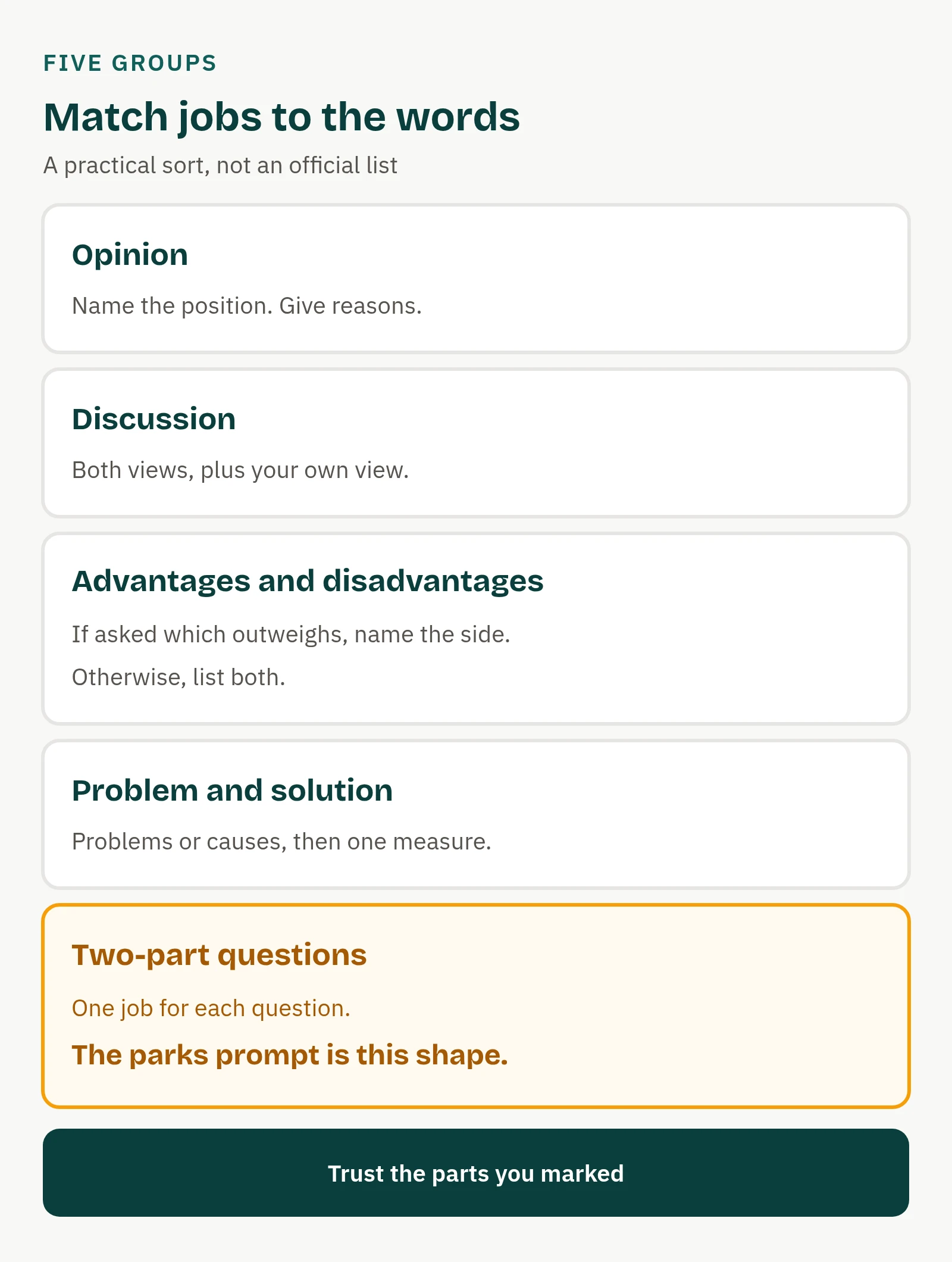
Opinion. Name the position. Give reasons. Use this to agree, to disagree, to say to what extent, or to judge a development as positive or negative. The opinion guide stays with that job. If the words ask for a degree, include it. A concession inside a paragraph does not replace the position.
Discussion. Both views, plus your own view. Each view needs a job, and your view needs one too. Body 2 can hold your view and still treat the other view fairly. If that crowds the paragraph, give your view a short third body. Choosing neither leaves a part with no job.
Advantages and disadvantages. If asked which outweighs, name the side. Otherwise, list both. “Do the advantages outweigh the disadvantages?” needs the heavier side in the outline. “What are the advantages and disadvantages?” needs one job for each side. Do not invent a winner that question did not ask for.
Problem and solution. Problems or causes, then one measure. Three problems and a conclusion that says “the government should act” is not a solution yet. Name the measure in the outline so the paragraph has somewhere to go.
Two-part questions. One job for each question. The two-part guide is the same rule at more length. The second question is not a remark saved for the conclusion. The parks prompt is this shape: why a council might choose parks, then whether that result is positive or negative. It is not two reasons for one side.
Write the position, then one job per paragraph
When the prompt asks for a view, write it in one sentence before you assign jobs. If you cannot, you are not ready to write the essay.
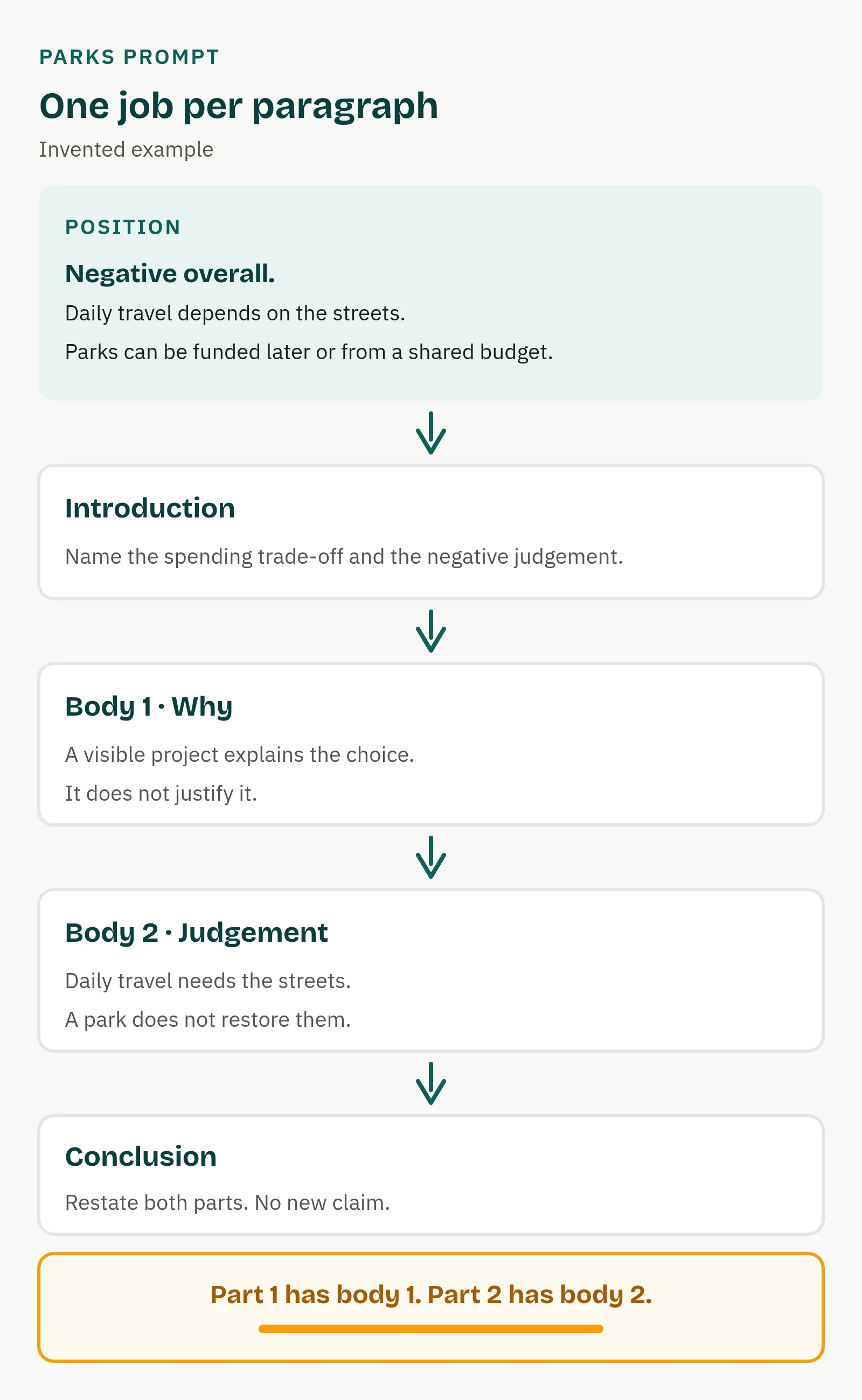
For the parks prompt the position is: negative overall, because daily travel depends on the streets, while parks can be funded later or from a shared budget. The budget sentence blocks “never build a park.” The “why” is still required, in its own paragraph.
Introduction. Name the spending trade-off and the negative judgement. Do not spend it on the reason that needs a whole paragraph.
Body 1. A visible project explains the choice. It does not justify it. The support is concrete: a new park is easier to show the public than a repaired road. Explain that, then stop, before the judgement.
Body 2. Daily travel needs the streets. A park does not restore them. People need the street on an ordinary day. Parks stay where the position put them: later, or from a shared budget.
Conclusion. Restate both parts. No new claim.
A coverage check
Before the first sentence of the essay, read the outline against the prompt.
- Part 1 has body 1. Part 2 has body 2.
- The introduction and the conclusion name the same judgement as the position.
- Each body paragraph has its support written down, not only the word “parks” or “streets”.
If a mark has no job, add one or change one. Keep the outline short enough to scan: the position, four jobs, two supports.
Make the thesis and the topic sentences match
The thesis is the position sentence in the introduction. A topic sentence is the first sentence of a body paragraph. It announces that paragraph’s job in words a reader can line up with the thesis.
For this prompt the thesis is:
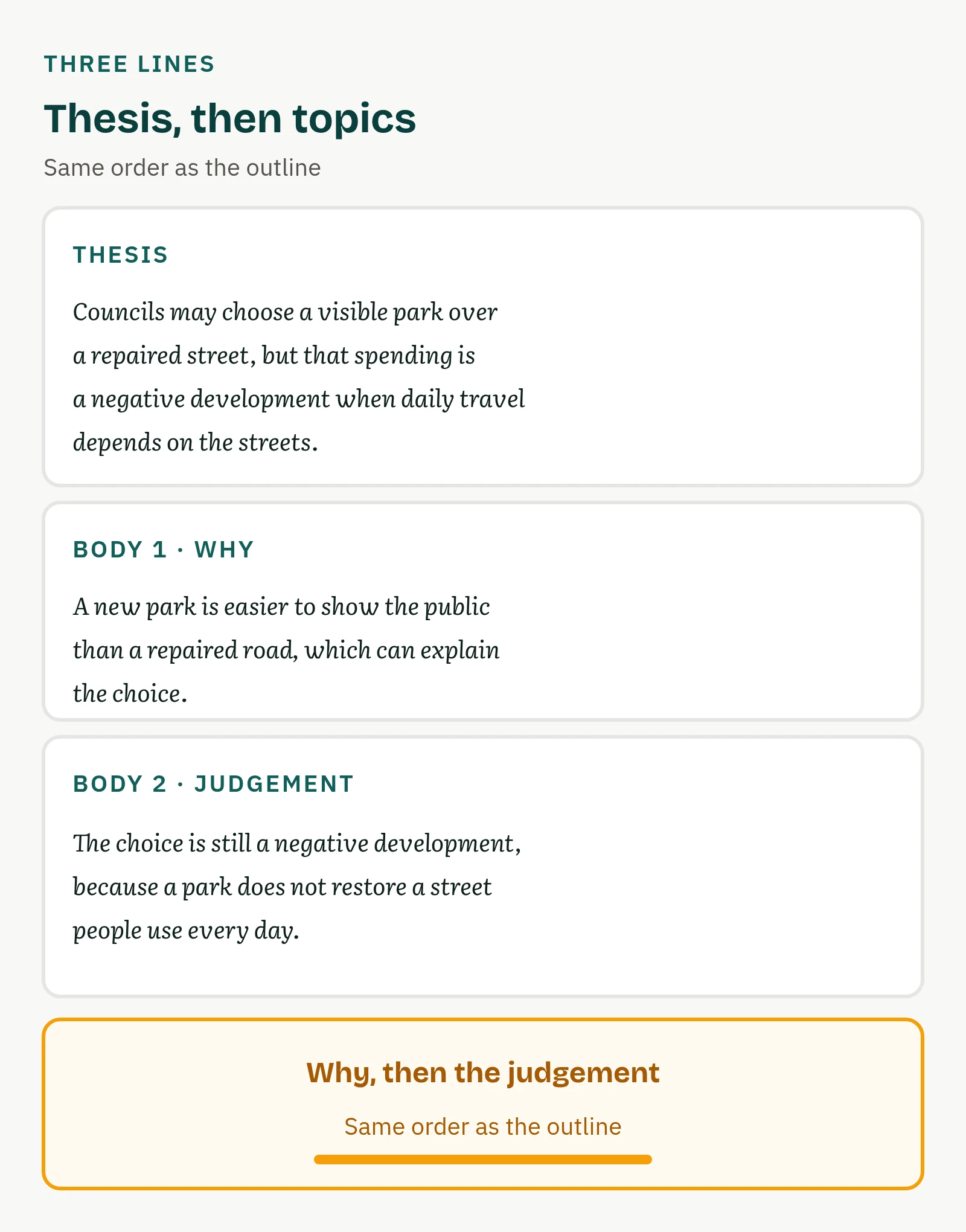
Councils may choose a visible park over a repaired street, but that spending is a negative development when daily travel depends on the streets.
The first half is the “why”. The second half is the judgement. The order matches the outline. A reader who stops after the introduction already knows both jobs.
Topic sentence for body 1:
A new park is easier to show the public than a repaired road, which can explain the choice.
Topic sentence for body 2:
The choice is still a negative development, because a park does not restore a street people use every day.
Cover the thesis and read only those two sentences. You should still see both parts. Same order as the outline: why, then the judgement. Body 1 explains the choice and does not deliver the verdict. Body 2 keeps the negative position.
Write the check as three lines before you write paragraphs: the thesis, then body 1’s topic sentence, then body 2’s. Part 1 should be visible in line 2, and part 2 in line 3.
“Parks and streets both matter in a modern city” fails that test. It could open a different prompt, and the judgement is missing. The outline may change while you plan. It may not disagree with itself: replace the support, the thesis, and the topic sentence together. A new idea that the conclusion cannot hold stays out.
Planning mistakes that drop a part
A memorised skeleton. “Introduction, advantage, disadvantage, conclusion” on the parks prompt never answers the “why”, or never judges.
The essay written twice. Jobs, the position, and the two supports are enough. Prose belongs in the essay.
A word list. Vocabulary does not say what body 2 is for. Words come after the jobs.
A view saved for the end. When a view is required, it is the first line of the outline, not a surprise in the conclusion.
Two jobs in one paragraph. The “why” and the judgement both in body 1 leave part 1 thin. Task Response in IELTS Task 2 is that shape once the essay is finished. Repair it in the outline: one job per paragraph.
A Task 1 plan. Charts and letters are a different paper. This outline is for a Task 2 essay. Band7 is for that essay only.
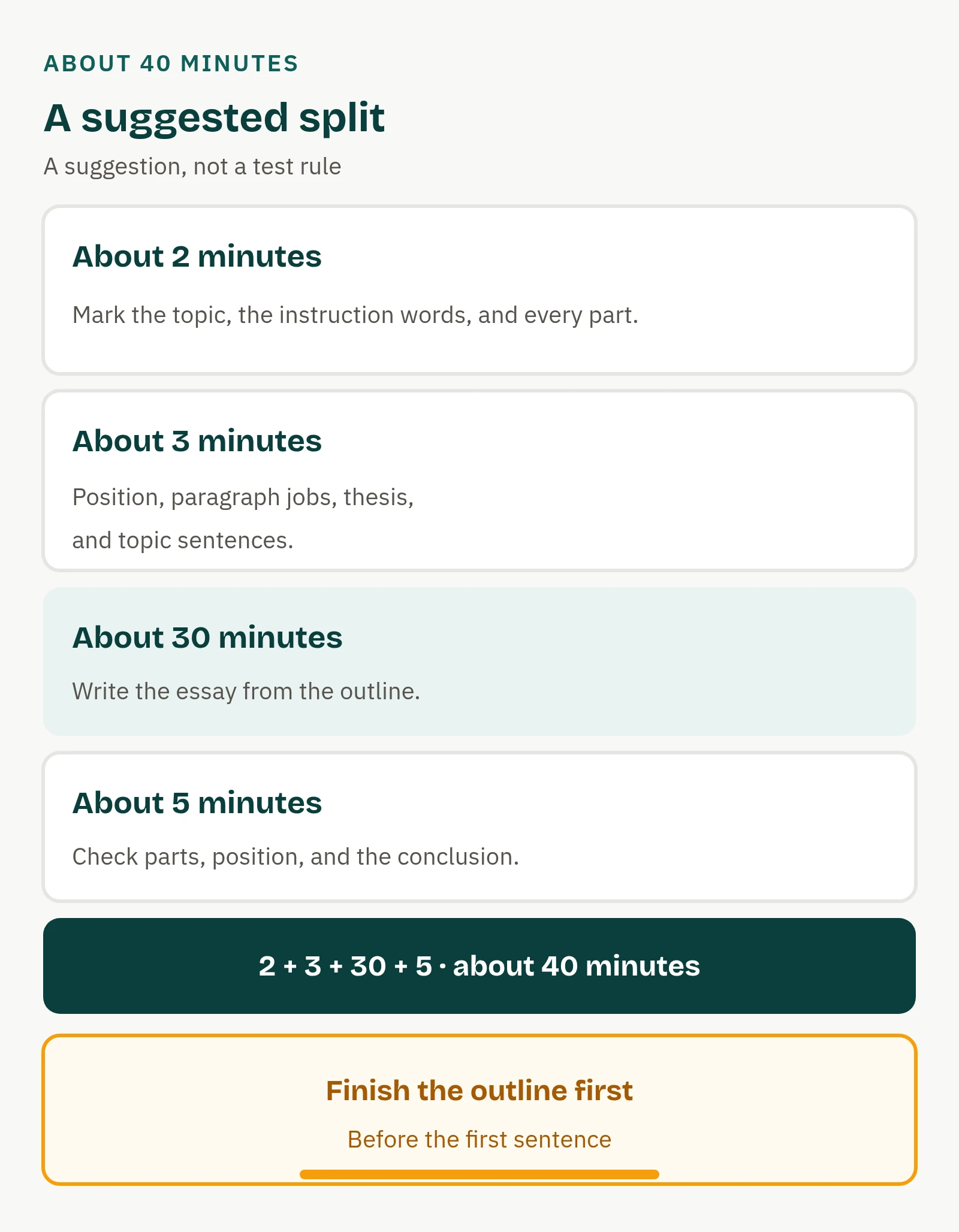
A suggested split of the 40 minutes
A suggestion, not a test rule. Shift the numbers if you know your pace. Do not drop the last check to buy writing time.
- About 2 minutes: mark the topic, the instruction words, and every part.
- About 3 minutes: write the position, the paragraph jobs, the thesis, and the topic sentences.
- About 30 minutes: write the essay from the outline. The task asks for at least 250 words. Length does not repair a skipped part.
- About 5 minutes: check parts, position, and the conclusion.
2 + 3 + 30 + 5 is the same about 40 minutes. Finish the outline before the first sentence.
Holding the whole sitting to the clock is a separate skill: How to practise IELTS Task 2 under timed conditions. On Band7 you write on the Writing Desk. Coach keeps in-writing help on. Mock turns in-writing AI off and runs a timer. Use Mock for that rehearsal, and do not pause to ask for a sentence.
Submit, then read the Grade Report: criterion notes and Examiner Feedback on that essay. The figures are Estimated Bands, practice figures in whole and half bands, so you can pick one change for the next outline. They do not forecast test day. How they are made is on How Estimated Band works. The step from 6.0 to 6.5 is How to move from 6.0 to 6.5 on IELTS Task 2. What a checker can and cannot say is in What to expect from an AI IELTS Task 2 practice checker. To check an essay you already wrote against the four criteria, use the IELTS Writing Task 2 checker.
Then stop planning and write the essay that answers this prompt.
Related posts
- How to practise IELTS Task 2 under timed conditions
A suggested 40-minute Task 2 rehearsal: plan, write, and check with the timer on, then read the Grade Report after you stop.
- Task Response in IELTS Task 2
Task Response on IELTS Writing Task 2: cover every part, hold one position, and develop ideas before you submit.
- Coherence and Cohesion in IELTS Task 2
Coherence and Cohesion on Task 2 is whether a reader can follow the argument, each paragraph job, and the links.
Browse every post on the Blog, or read the FAQ on Estimated Bands.
Write on the Writing Desk
Free accounts get 2 Grade Reports every calendar month, with Coach tools included.