How to practise IELTS Task 2 under timed conditions
IELTS Writing Task 2 is one essay in about 40 minutes, at least 250 words. In the Writing score, Task 2 is worth twice as much as Task 1. Untimed work hides the clock. Looking a phrase up, or taking a sentence from a helper, produces a piece tidier than you can finish on the day.
This is the rehearsal. One prompt, the Task 2 question. One essay, that prompt plus the body. On Band7, write it on the Writing Desk in Mock: in-writing AI off, timer running. Coach, with in-writing help on, is a different session.
Why timed rehearsal is a separate skill
An outline is the paragraph-level plan beside the essay. It names each paragraph's job. It is not the body. Building one is How to plan an IELTS Writing Task 2 essay. The sitting asks three things an outline cannot answer.
- Do you finish, including a conclusion that answers the prompt?
- Do you keep the position you chose, or drop it when the minutes get short?
- Do you still cover every part of the prompt when you cannot pause to look something up?
A suggested 40-minute budget
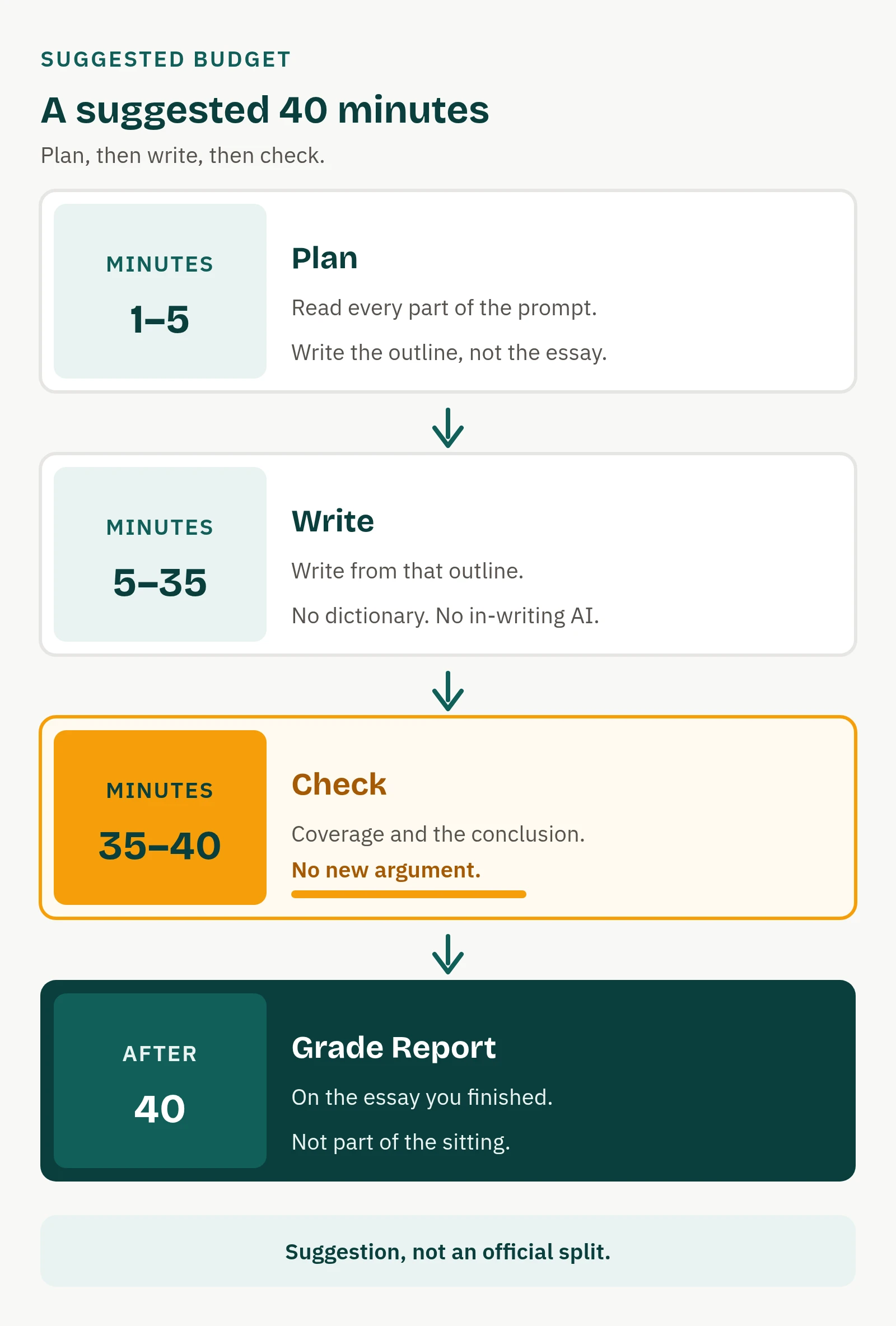
Plan, then write, then check. The minutes are a suggestion, not an official split. Shift them when the same stall shows up in more than one log.
Minutes 1–5. Plan. Read every part of the prompt. Write the outline, not the essay.
Minutes 5–35. Write. Write from that outline. No dictionary. No in-writing AI.
Minutes 35–40. Check. Coverage and the conclusion. No new argument. Fix a slip that hides meaning. Leave a sentence you merely dislike.
After minute 40. Stop. The Grade Report is next, on the essay you finished, not part of the sitting.
Example. A prompt invented for this article, not an official question. The outweigh shape is in the advantages and disadvantages guide.
Some employers require staff to be available on messaging apps after working hours. Do the advantages outweigh the disadvantages?
Outline jobs: disadvantages outweigh. Body 1, rest versus work, because constant contact blurs the end of the day. Body 2, after-hours contact still useful, because a rare urgent message can earn its place and that does not reverse the judgement. Conclusion: disadvantages outweigh. No new claim. Leave a reason out of those jobs and you will search for it while the clock runs.
Set the rules before minute 1
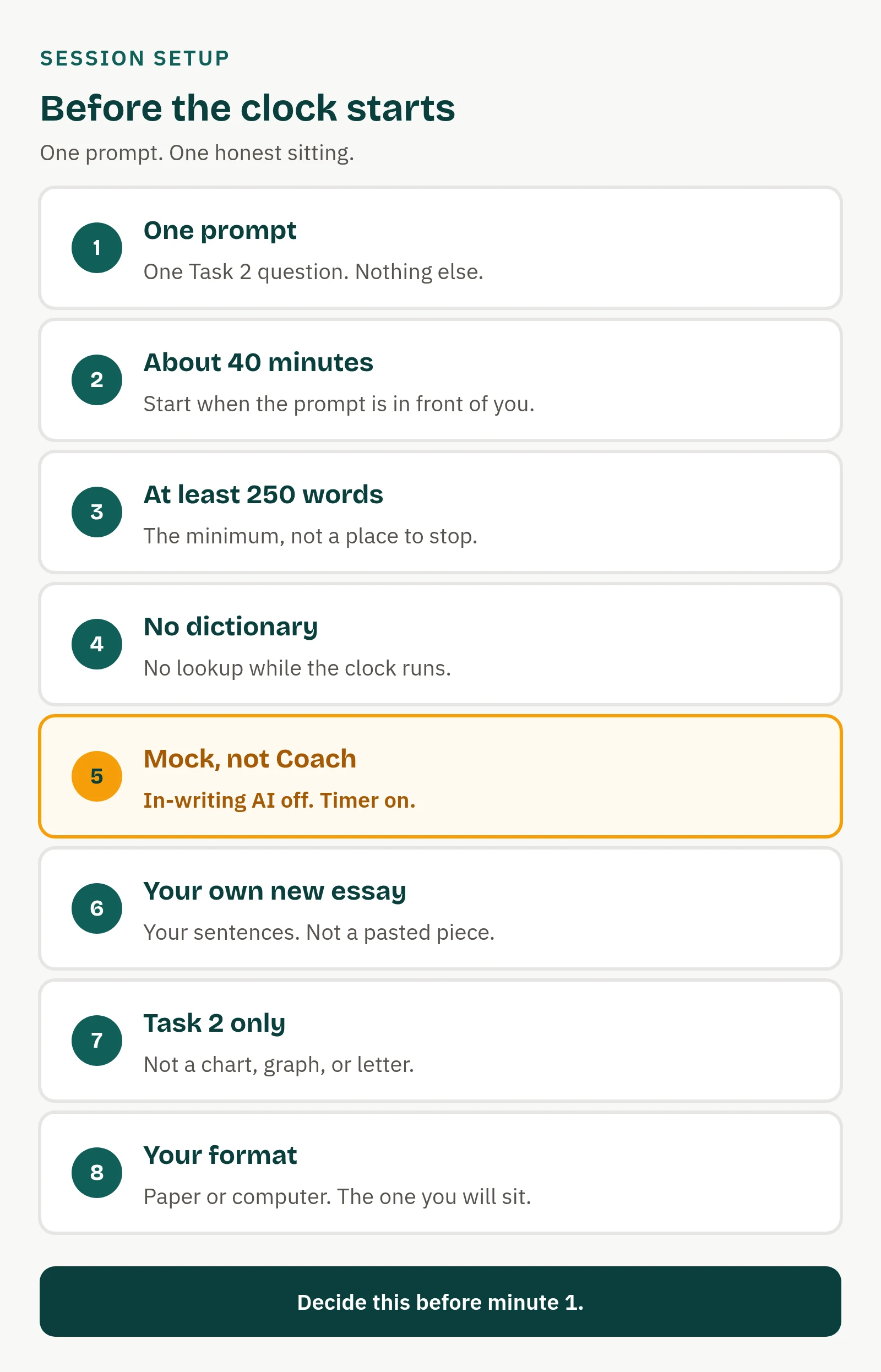
Decide the rules before the clock starts. Minute 20 is a bad time to invent them.
One prompt. One Task 2 question. Nothing else. Pick it before you start — browse Task 2 topics, or match the instruction under question types. A new question mid-sitting is a new rehearsal, not a way out of a hard one.
About 40 minutes. Start when the prompt is in front of you. A draft already written in another window does not belong to this clock.
At least 250 words. The minimum, not a place to stop. The extra words, past a thin 250, should be support inside a paragraph you planned. A side topic only inflates the count.
No dictionary. No lookup while the clock runs. Use a plain word you know, and keep the meaning clear. The word you cannot find is part of what the sitting shows you.
Mock, not Coach. In-writing AI off. Timer on. You will not have that help in the exam. Coach will offer it while you write. Leave that for another session, and save the comment you want until after you submit.
Your own new essay. Your sentences. Not a pasted piece. An old essay sent in for a number skips the clock. So does a published essay rewritten from memory.
Task 2 only. Not a chart, graph, or letter. That paper has its own timing, and this clock does not train it.
Your format. Paper or computer. The one you will sit. Handwrite if you will handwrite, and see whether the last paragraph stays readable. Type if you will type. Same window, no dictionary either way. A pen or a keyboard, and the prompt — not yesterday's word list.
Then start. If a job is still unclear, write the sentence you can defend and log the stall at the end. Do not stop the timer to rebuild the outline from nothing.
Where you want to be
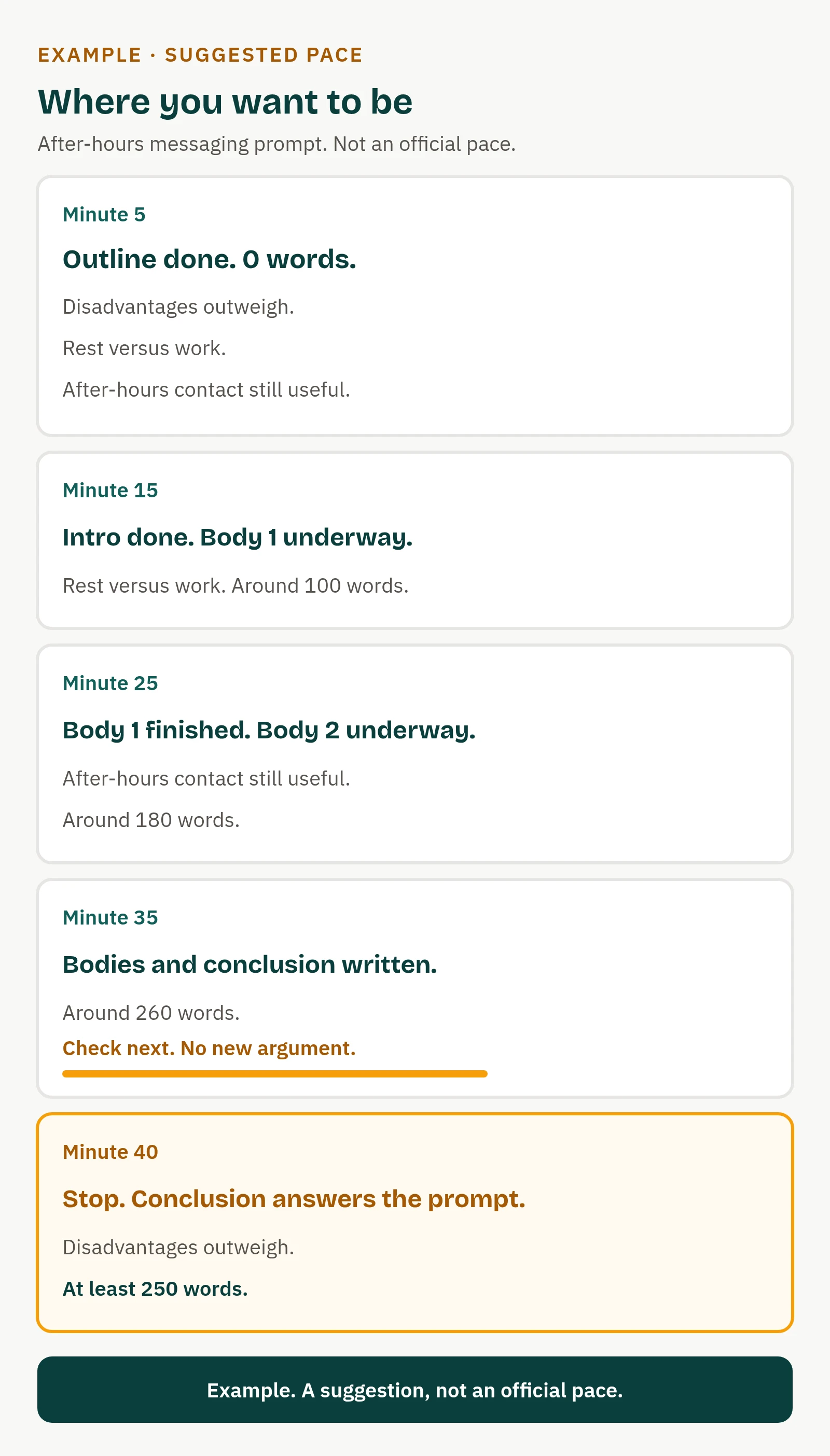
Checkpoints tell you where the essay should be, while you can still act on a stall. These marks are a suggestion for the after-hours messaging prompt above, not an official pace. Write them down before you start if you need to see them. If you write faster than this, keep the same jobs and spend the spare minutes on the conclusion and a coverage check.
Minute 5. outline done. 0 words. Disadvantages outweigh. Rest versus work. After-hours contact still useful. The essay has not started, and that is the point. The conclusion job is already named: disadvantages outweigh. No new claim.
Minute 15. Intro done. Body 1 underway. Rest versus work. Around 100 words. If the first sentence is still being rewritten, leave it and write the support for body 1.
Minute 25. Body 1 finished. Body 2 underway. After-hours contact still useful. Around 180 words. If that paragraph has no second sentence, write the reason from the outline. Do not open a third idea.
Minute 35. Both body paragraphs and the conclusion written. Around 260 words. Check next. No new argument. The conclusion restates the judgement. It is not a new opening paragraph.
Minute 40. Stop. Conclusion answers the prompt. Disadvantages outweigh. At least 250 words. Short at minute 35? Add support inside a body you already planned. Do not start a fresh topic as the clock ends.
The numbers are a careful pace, not a quota. A faster sitting can pass 250 well before minute 35. What stays fixed is the job at the mark: the outline at minute 5, both bodies and the conclusion written by minute 35, and a checked essay that answers the prompt at minute 40. If you reach the conclusion early, use the spare minutes on coverage, not on a new argument.
If the clock runs short
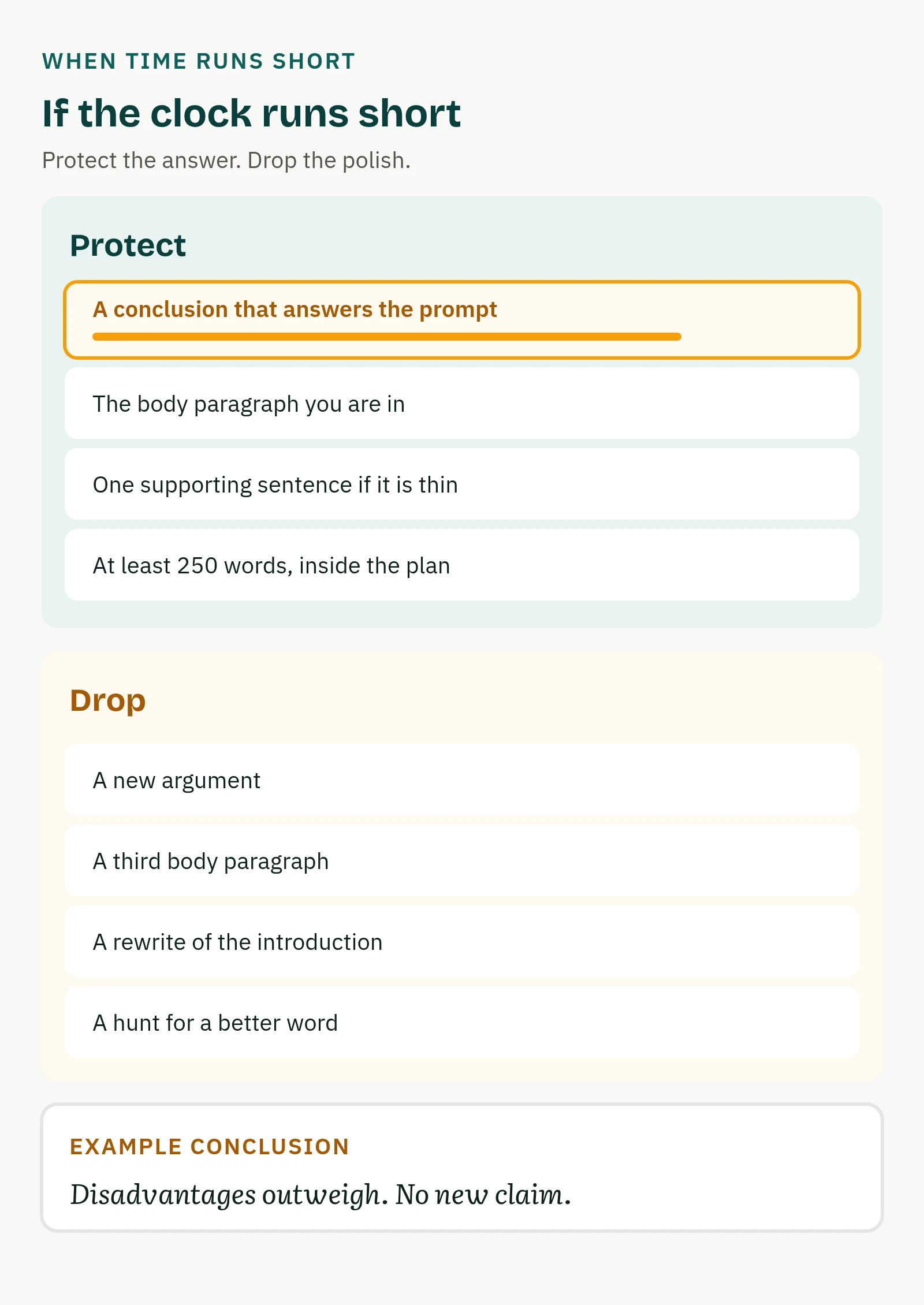
Protect the answer. Drop the polish. You can usually see the problem before the last minute, which is why the checkpoints exist.
The four criteria are equally weighted: Task Response, Coherence and Cohesion, Lexical Resource, and Grammatical Range and Accuracy. Triage does not replace them. It protects the part of this essay that answers the prompt. The public names are in the key assessment criteria PDF, and a plain explainer is on IELTS Writing band descriptors.
What to protect
A conclusion that answers the prompt. Here the job is short: disadvantages outweigh. No new claim. Task Response is whether the essay answers this prompt, including a clear position when the question asks for one. Never stating the judgement leaves that part thin. Task Response in IELTS Task 2 is the closer diagnosis.
The body paragraph you are in. Finish it. One idea, plus the support you named, is a complete paragraph.
One supporting sentence if it is thin. Add it inside that paragraph. That is how you move towards at least 250 words without a new topic.
At least 250 words, inside the plan. Extend a paragraph whose job is already on the outline. A new topic at the end adds a claim the conclusion cannot carry.
What to drop
A new argument. A third reason at minute 36 will not fit the conclusion you still have to write.
A third body paragraph. Two jobs were enough. A third one leaves a fragment.
A rewrite of the introduction. The opening can stay plain.
A hunt for a better word. A clear sentence stays. Change a word only when it hides the meaning.
If minute 35 comes and a body is still open, close it in two or three plain sentences, write the conclusion, and stop.
What to write down when you stop
The checkpoints were the aim. The log is what happened. Before any feedback, note four things: how long plan, writing, and check took; where you stalled; how many words you wrote; and what the next outline has to hold.
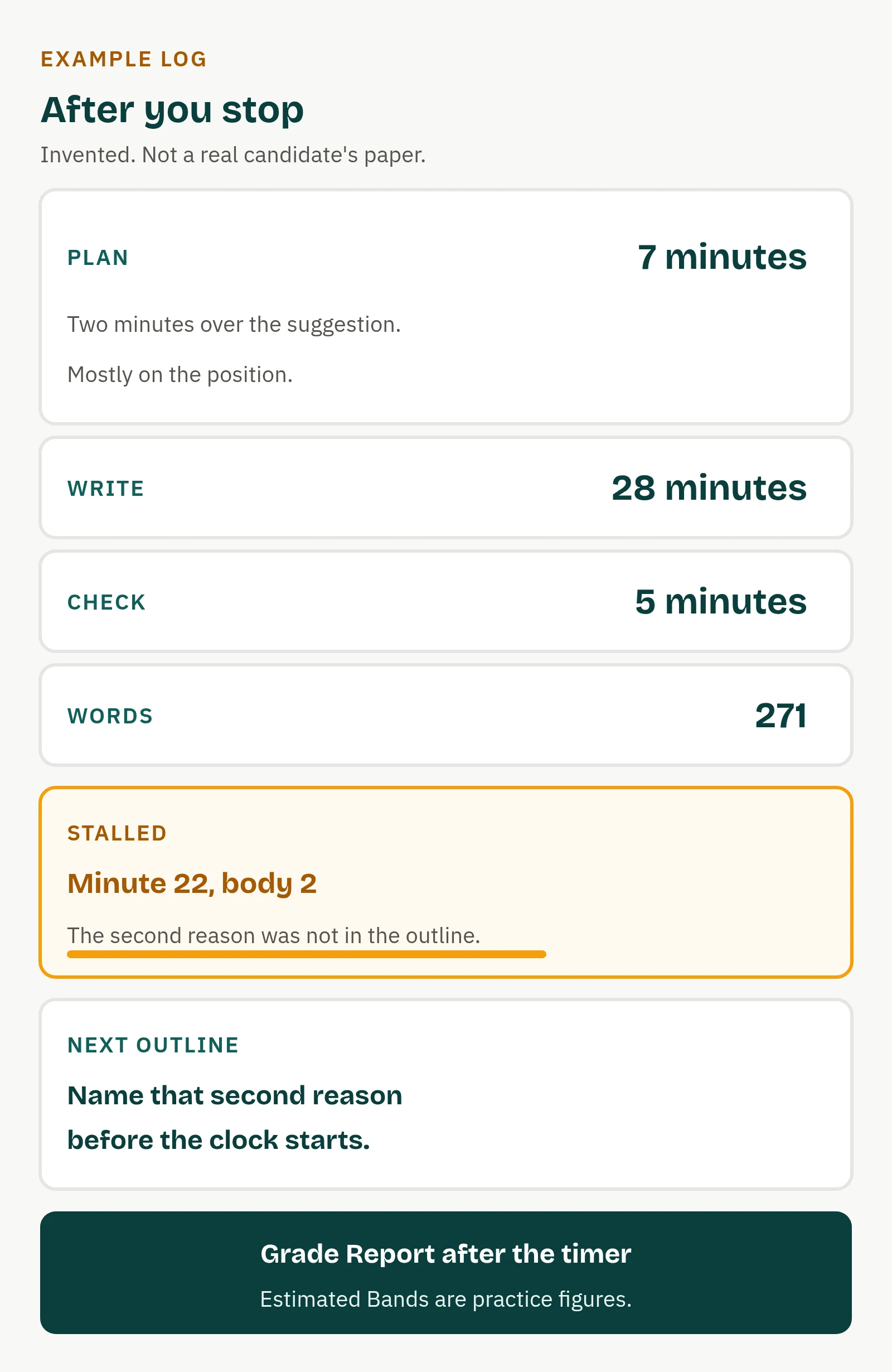
Example. A log for the after-hours messaging prompt, invented for this article, not a real candidate's paper. The job was named. The reason was not.
- Plan: 7 minutes. Two minutes over the suggestion. Mostly on the position.
- Write: 28 minutes.
- Check: 5 minutes.
- Words: 271.
- Stalled: minute 22, body 2. The second reason was not in the outline.
- Next outline: name that second reason before the clock starts.
The stages still add up to forty minutes, so the check happened. The leak was a long plan and a body job with no reason. "Timing was bad" would have hidden both.
Submit that essay. Read the Grade Report after the timer, with the log beside it. You get an Overall figure, a figure for each criterion, and Examiner Feedback that should quote your sentences. Estimated Bands are practice figures in whole and half bands, not an official result. The method is How Estimated Band works. The limits of the comments are in What to expect from an AI IELTS Task 2 practice checker.
One fix follows from the pair of notes. The next outline names the reason: a rare urgent message can earn its place, and that does not reverse the judgement. If the feedback instead quotes a rush of errors near the end, the next check keeps two minutes for those slips. A rewrite with help after the timer is study, not a second timed essay. The next rehearsal is a new prompt, in Mock, from a standing start.
Full sittings and shorter drills
A full timed essay rehearses the whole window. A drill rehearses one stage. There is no required weekly number. One full Mock a week is a suggestion, not a programme. If that is too much, one a fortnight still gives you a log to compare.
On a shorter day, drill one stage: five minutes on an outline, ten on a conclusion, or one body paragraph. That is not a timed essay. Match it to the stall in the log, then check on the next full sitting. If you are aiming from around 6.0 to 6.5, read How to move from 6.0 to 6.5 on IELTS Task 2.
The next essay tests the note
Open the Writing Desk, choose Mock, and put one prompt on the page. Plan, write, check, stop, log, then read the Grade Report. If you wrote the sitting on paper, type it into the Task 2 checker instead. The free grant of reports is on Pricing.
Related posts
- Task Response in IELTS Task 2
Task Response on IELTS Writing Task 2: cover every part, hold one position, and develop ideas before you submit.
- Coherence and Cohesion in IELTS Task 2
Coherence and Cohesion on Task 2 is whether a reader can follow the argument, each paragraph job, and the links.
- Grammatical Range and Accuracy in IELTS Task 2
Grammatical Range and Accuracy on Task 2 is varied sentence building, and errors that do not block the reader.
Browse every post on the Blog, or read the FAQ on Estimated Bands.
Write on the Writing Desk
Free accounts get 2 Grade Reports every calendar month, with Coach tools included.