Task Response in IELTS Task 2
You can write a tidy Task 2 essay and still miss the question. The sentences work. Task Response still fails, because a reader cannot find an answer to this prompt, the question on the page.
Task 2 has four criteria, equally weighted: Task Response, Coherence and Cohesion, Lexical Resource, and Grammatical Range and Accuracy. This article is only the first. The other three, with the official PDFs, are on IELTS Writing band descriptors. Charts and General Training letters are a different paper.
What Task Response is checking
From the public criteria, in our words: address all parts of the task; hold a clear position throughout, with conclusions that stay relevant to it; present, extend, and support the main ideas; keep those ideas on this question. Public task instructions also require a connected text. Notes or bullet points are penalised. The band tables call that an inappropriate format.
The band tables also flag uneven parts, conclusions that are unclear or repetitive, and support that over-generalises. The exact lines are in the PDFs linked from IELTS Writing band descriptors.
Every part needs a paragraph job
The parts change with the prompt. These are common shapes, not an official list. The Task 2 question types pages set out the parts each shape asks for. A bare yes misses “to what extent”. Never choosing misses a discuss-both question. An outweigh question needs both sides and a judgement. A problem, a cause, or a solution is its own part when the prompt names it, and two direct questions need answers that do not contradict.
The outline is the paragraph plan beside the essay, not the essay. Give each part a job before the first sentence. How to plan an IELTS Writing Task 2 essay is the method. A suggestion, not a rule: a few minutes on that plan, then write.
Example. An original prompt, invented for this article, not an official question. More practice, grouped by subject, is on Task 2 topics.
Some people think universities should focus on job skills. Others think they should focus on academic subjects. Discuss both views and give your own opinion.
The leak: no view in the opening, one side in each body, and a conclusion that says both matter. There is no clear position. “Give your own opinion” had no paragraph job. Those are missing parts.
Name the opinion first: Academic subjects stay the core; job skills take a smaller share. That part is often skipped, so put it in the introduction and again in the conclusion.
- Introduction: Name both views and the opinion.
- Body 1: Academic subjects as the core.
- Body 2: Job skills as a smaller share. This discusses the other view without dropping the core.
- Conclusion: Restate the same opinion.
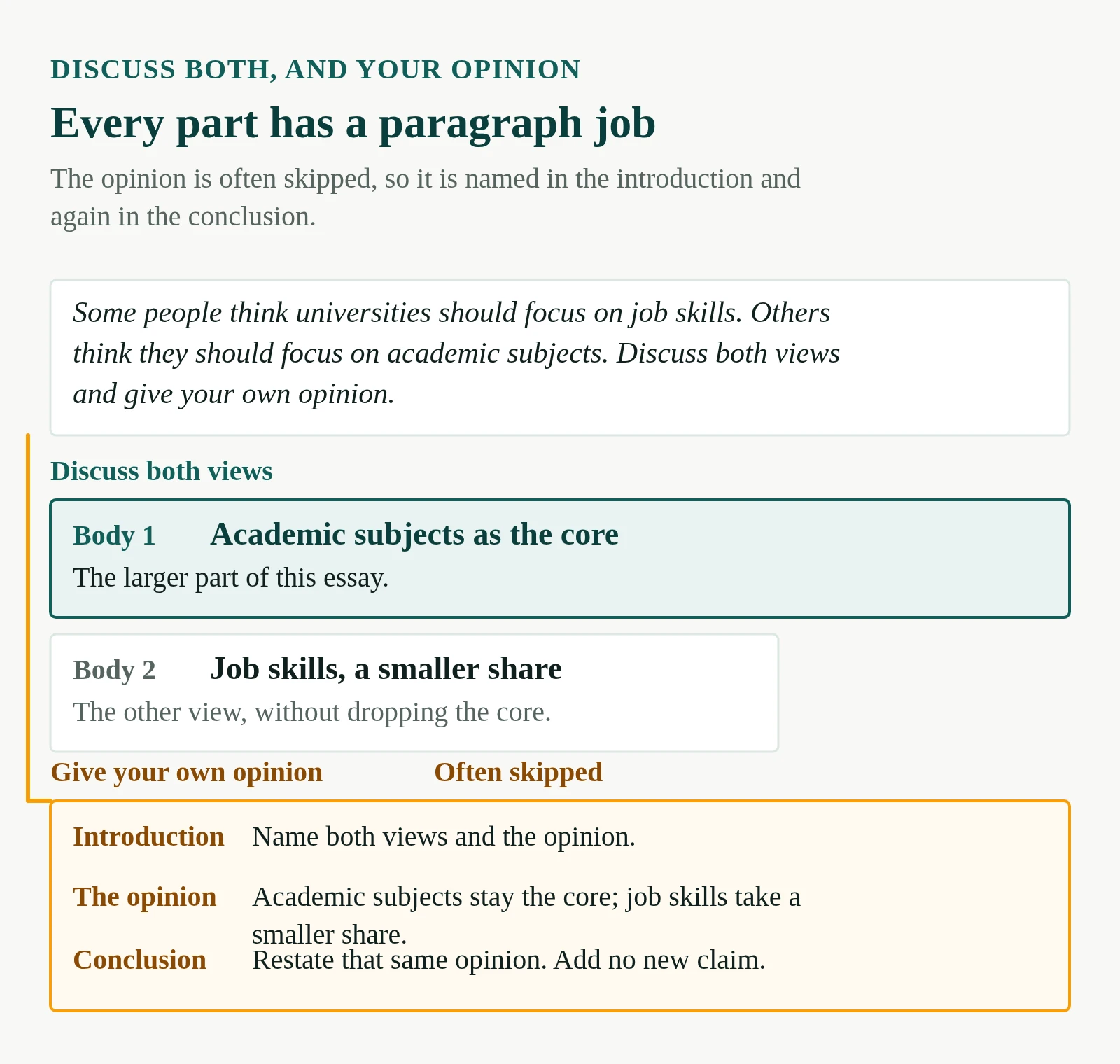
A position you can find all the way through
A position is the view the prompt asked for. On an agree question it is how far you agree, not a bare yes. On a discuss-both question it is your choice, including a qualified one like the line above. On an outweigh question it is which side weighs more. Clear throughout means a reader gets the same answer from the introduction, the body, and the conclusion. On an agree question, a degree that appears only in the last line has not been doing any work. The reasons above it are not yet reasons for a view.
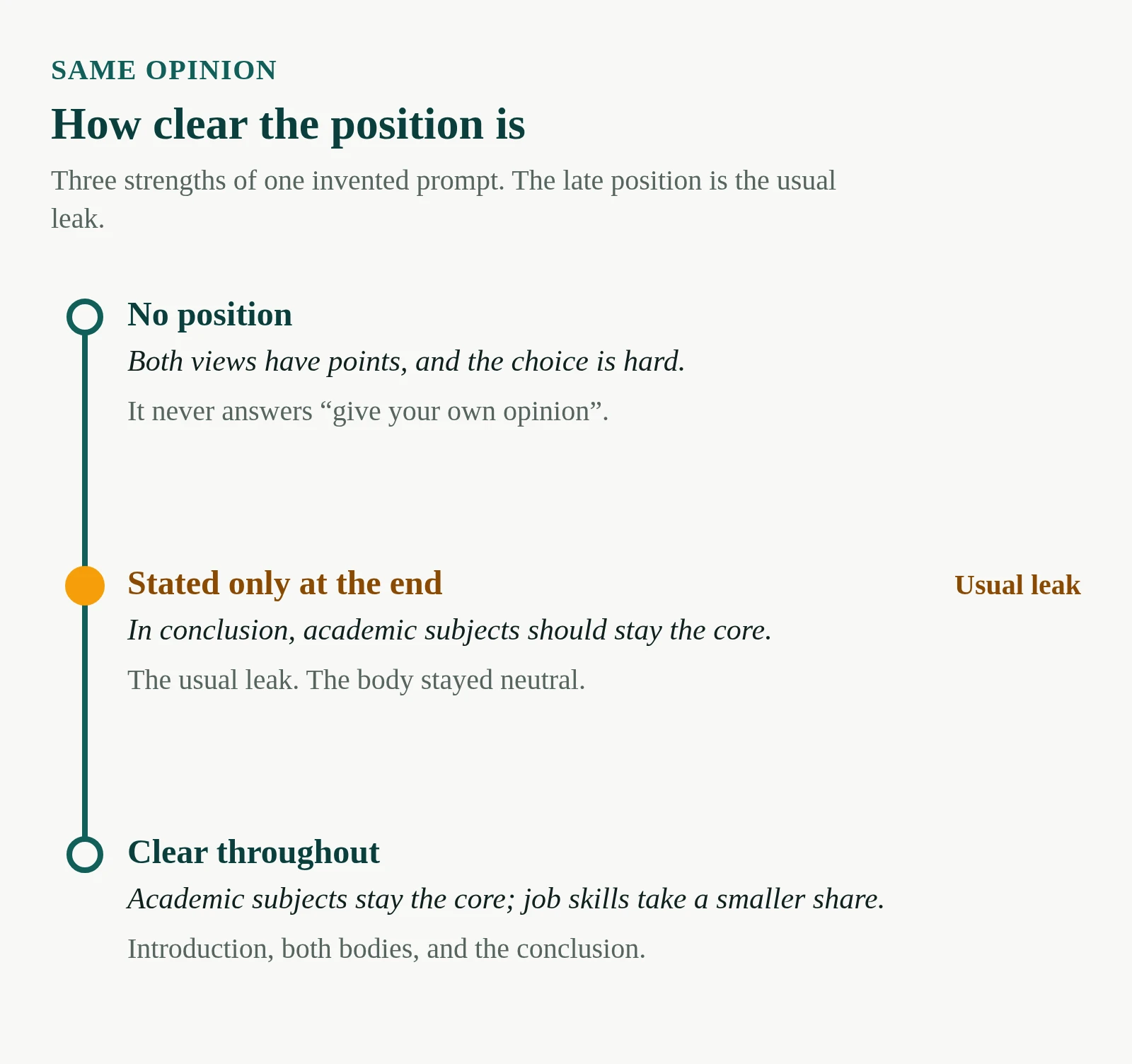
Three strengths of the same invented prompt:
No position. “Both views have points, and the choice is hard.” It is about universities. It does not answer “give your own opinion”, so later paragraphs have nothing to follow.
Stated once. The body stays neutral, and the last sentence is “In conclusion, academic subjects should stay the core.” The view arrives only at the end. This is the usual leak. The band tables describe the same weakness when conclusions are unclear or repetitive.
Clear throughout. “Academic subjects stay the core; job skills take a smaller share.” Put that line in the introduction. Body 1 develops the core. Body 2 develops the smaller share and does not overturn it. The conclusion repeats the decision. The same line, from the opening to the conclusion, is the test. You may change the wording. You may not change the decision.
A shift is different from a late position. You open with academic subjects as the core, then close with “Job skills matter more, because employment is the point of a degree.” Both sentences are grammatical. They are not one position.
Write the position as one sentence in the outline before you start. Keep a later idea only when it still fits that sentence. If it needs a different conclusion, it belongs to a different essay.
Under-developed ideas
Under-developed ideas are the next leak. The paragraph names a claim and moves on. Task Response is not a word count: an essay can clear 250 words and still leave every idea thin. The public criteria ask whether main ideas are extended and supported, and whether that support stays relevant.
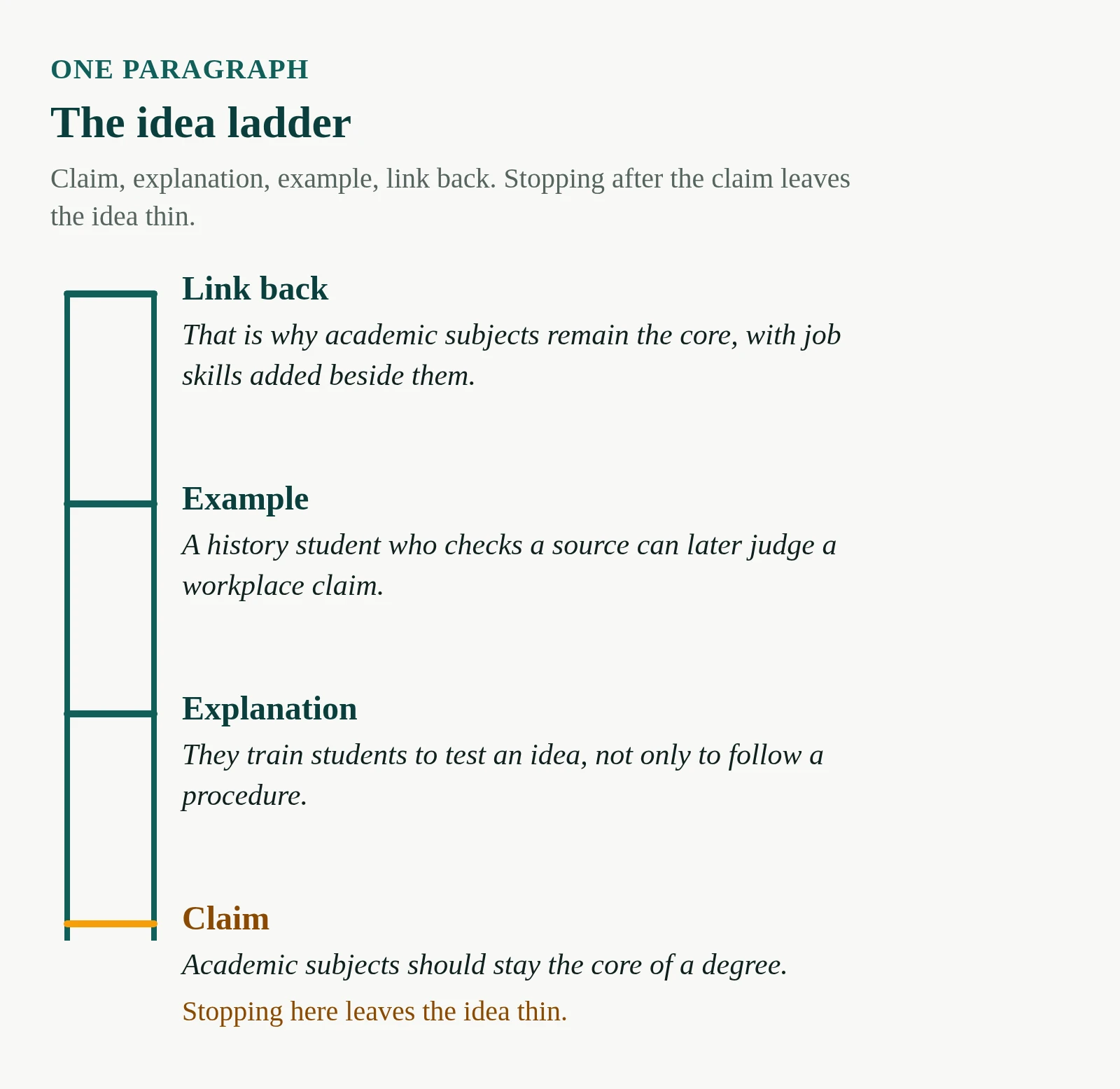
Use four steps in each body paragraph, one main idea only. This is a study method, not a line from the band table.
Claim. The point the paragraph exists to make.
Explanation. Why the claim is true, in your own reasoning, not a second claim disguised as a because.
Example. One concrete case, from your knowledge or your experience. It does not have to be a story about you.
Link back. A sentence that returns the case to this prompt and to the position. Without it, an interesting example can still miss the question.
Invented for this article, on the same prompt. This is the spine of one paragraph, not a full essay.
Claim. Academic subjects should stay the core of a degree.
Explanation. They train students to test an idea, not only to follow a procedure.
Example. A history student who checks a source can later judge a workplace claim.
Link back. That is why academic subjects remain the core, with job skills added beside them.
Stopping after the claim leaves the idea thin. Stopping after the explanation leaves it general. The example lets a reader check the support, and the link back keeps that check inside the opinion. A second example often becomes a second idea, and the paragraph loses its job.
Store the four steps as notes in the outline, not as sentences to paste. How to practise IELTS Task 2 under timed conditions is about protecting the writing time. A paragraph that is still only a claim near the end of the sitting needs extending, not a new idea.
Examples that leave the question
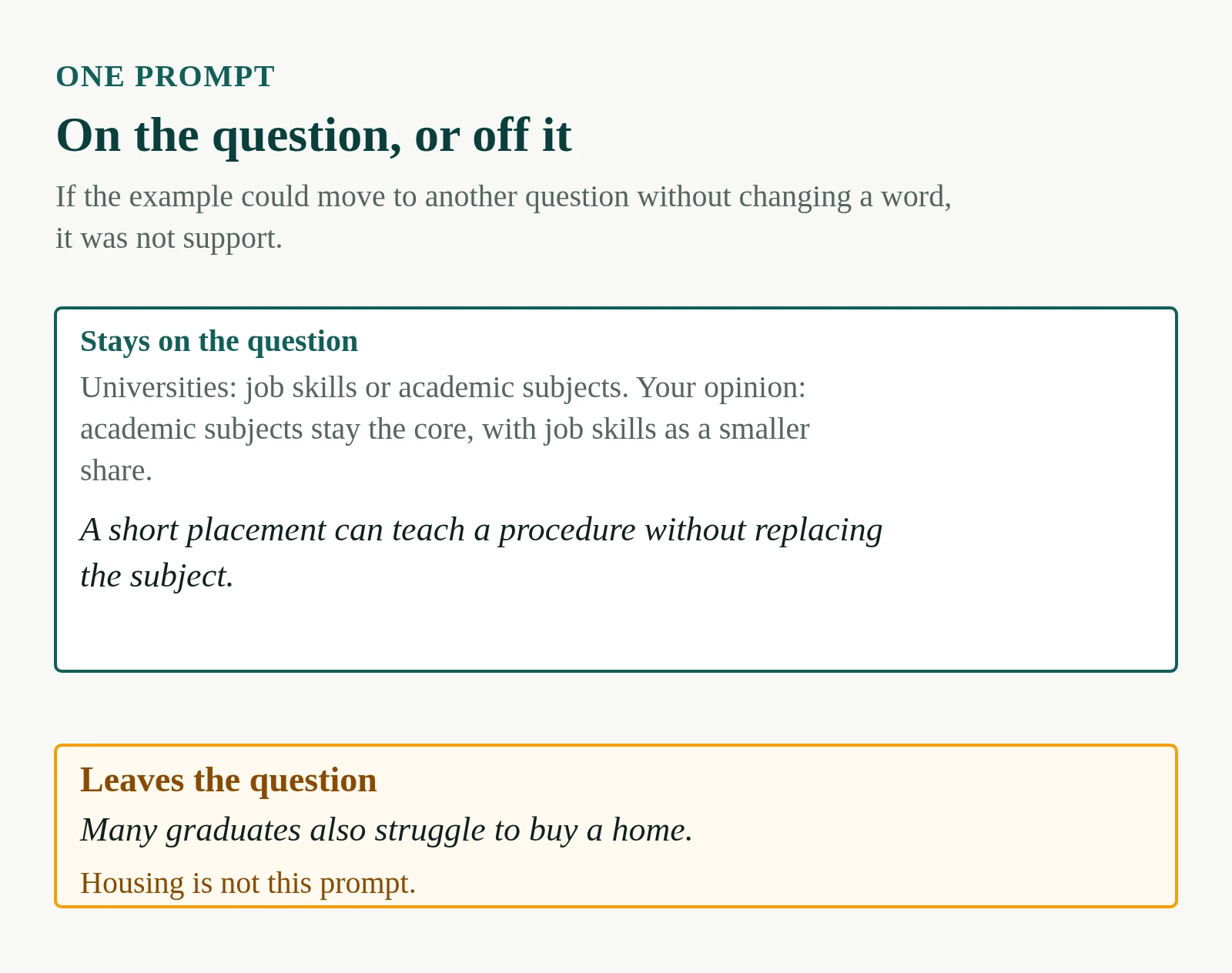
Relevance is easy to miss, because the sentences still sound like an essay. Four patterns on this prompt. Every sentence here is invented for this article.
An example that stays. “A short placement can teach a procedure without replacing the subject.” It shows job skills inside a degree, supports the smaller share, and refuses the replacement.
An example that drifts. “Many graduates also struggle to buy a home.” Housing may matter in life. It does not show why academic subjects should stay the core. Housing is not this prompt. If you can move an example to a different question without changing a word, it was not support. Cut it, or replace it with a case that could only belong here.
Support that is too general. “Education is important for society, and everyone benefits in many ways.” It could sit under almost any education question. “Everyone” and “many ways” feel like evidence until you ask what they have shown. The band tables note this over-general support, and support that loses focus, even where the main parts are addressed. One precise case does more work.
A memorised opening. “In today's modern world, the topic of education has become increasingly controversial.” It could open a dozen prompts. It names neither view, and it does not establish your position, which is the opening's job.
Try this instead: “Universities are often told to choose between job skills and academic subjects. Academic subjects should stay the core, with job skills as a smaller share.” The first sentence names the question. The second sets the position. Nothing in it could open an essay about housing. Memorised language is also a Lexical Resource problem. On Task Response the cost is simpler: the introduction never starts the answer, so reject that line before you write it.
Before you submit
About 40 minutes is the usual recommendation for Task 2, and the response needs at least 250 words. In the Writing score, Task 2 is worth twice as much as Task 1. The Writing band is reported as a whole or half band.
Write on the Band7 Writing Desk, then read the Grade Report, the result for one essay, the prompt plus the body. Mock runs a timer with in-writing help off. Coach leaves that help on when you are studying a paragraph. Examiner Feedback should quote your sentences and name the criterion. If the criterion to change is Task Response, put one fix in the next outline: the missing part, the position sentence, or the thin idea. To see which criterion is limiting an essay you already wrote, paste it into the Task 2 checker.
The figure on that report is an Estimated Band, a practice figure in whole and half bands, not an official result and not a forecast. What a checker can honestly tell you is in What to expect from an AI IELTS Task 2 practice checker. How the figures are produced is on How Estimated Band works. The free monthly allowance of Grade Reports is on Pricing.
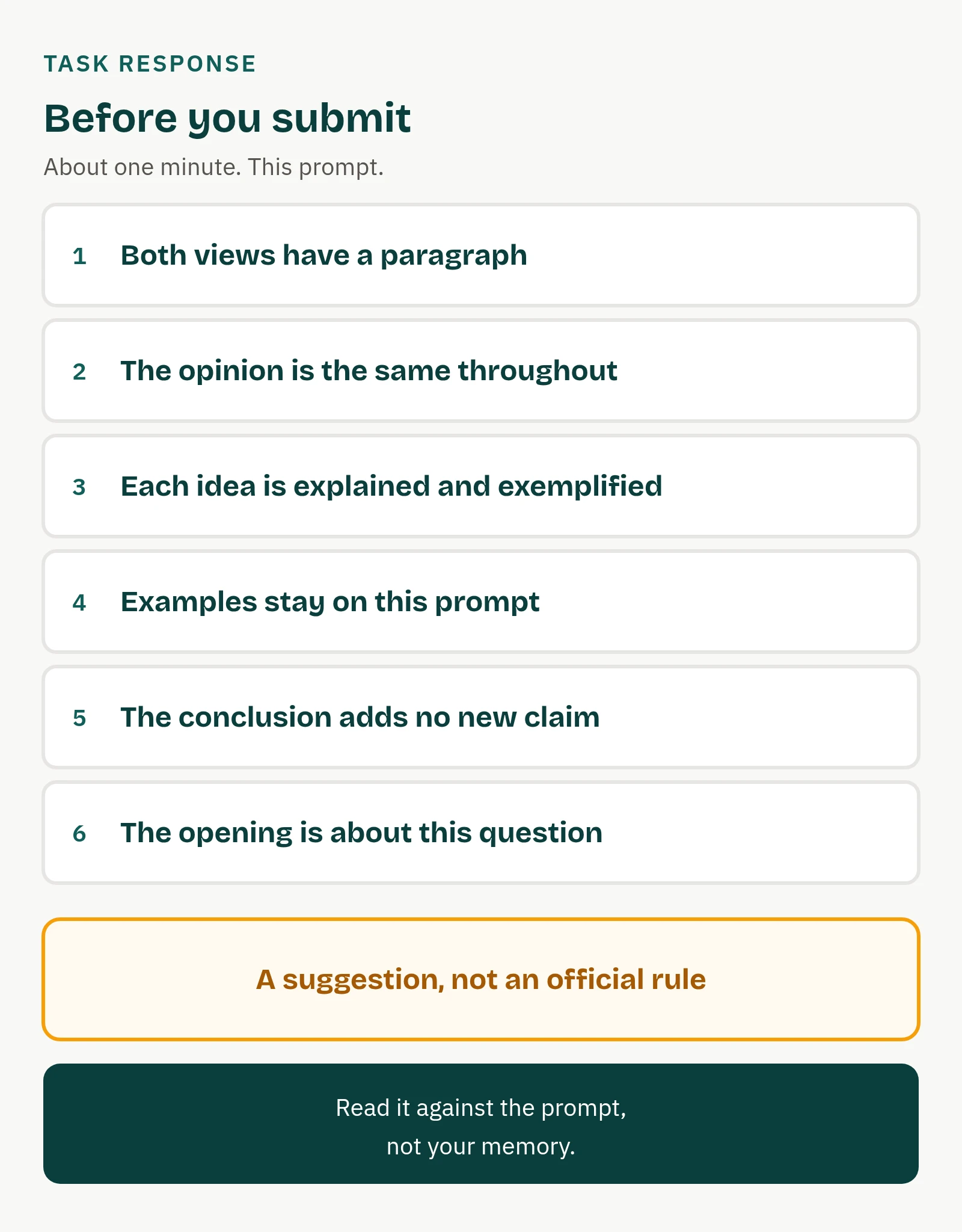
Read the essay against the prompt, not your memory of what you meant. About one minute. A suggestion, not an official rule, and it will not catch grammar.
Both views have a paragraph. Job skills and academic subjects each have a body job, not a mention saved for the conclusion.
The opinion is the same throughout. The introduction, both bodies, and the conclusion reduce to the sentence in the outline.
Each idea is explained and exemplified. A body that is only a claim is the thin idea from the ladder.
Examples stay on this prompt. The placement can stay. The housing sentence cannot.
The conclusion adds no new claim. A new reason in the last lines was never developed.
The opening is about this question. It names the two views and the position. A line about today's modern world would not.
One leak per sitting is enough. Set that leak beside the other three criteria in How to move from 6.0 to 6.5 on IELTS Task 2.
Related posts
- Coherence and Cohesion in IELTS Task 2
Coherence and Cohesion on Task 2 is whether a reader can follow the argument, each paragraph job, and the links.
- Grammatical Range and Accuracy in IELTS Task 2
Grammatical Range and Accuracy on Task 2 is varied sentence building, and errors that do not block the reader.
- Lexical Resource in IELTS Task 2
Lexical Resource on Task 2 is precise words, a range the sentence can carry, and topic vocabulary that belongs.
Browse every post on the Blog, or read the FAQ on Estimated Bands.
Write on the Writing Desk
Free accounts get 2 Grade Reports every calendar month, with Coach tools included.