Coherence and Cohesion in IELTS Task 2
You can put the paragraphs in a sensible-looking order and still lose the reader. The connectors are there. Coherence and Cohesion still fails, because the next idea does not follow from the one before it.
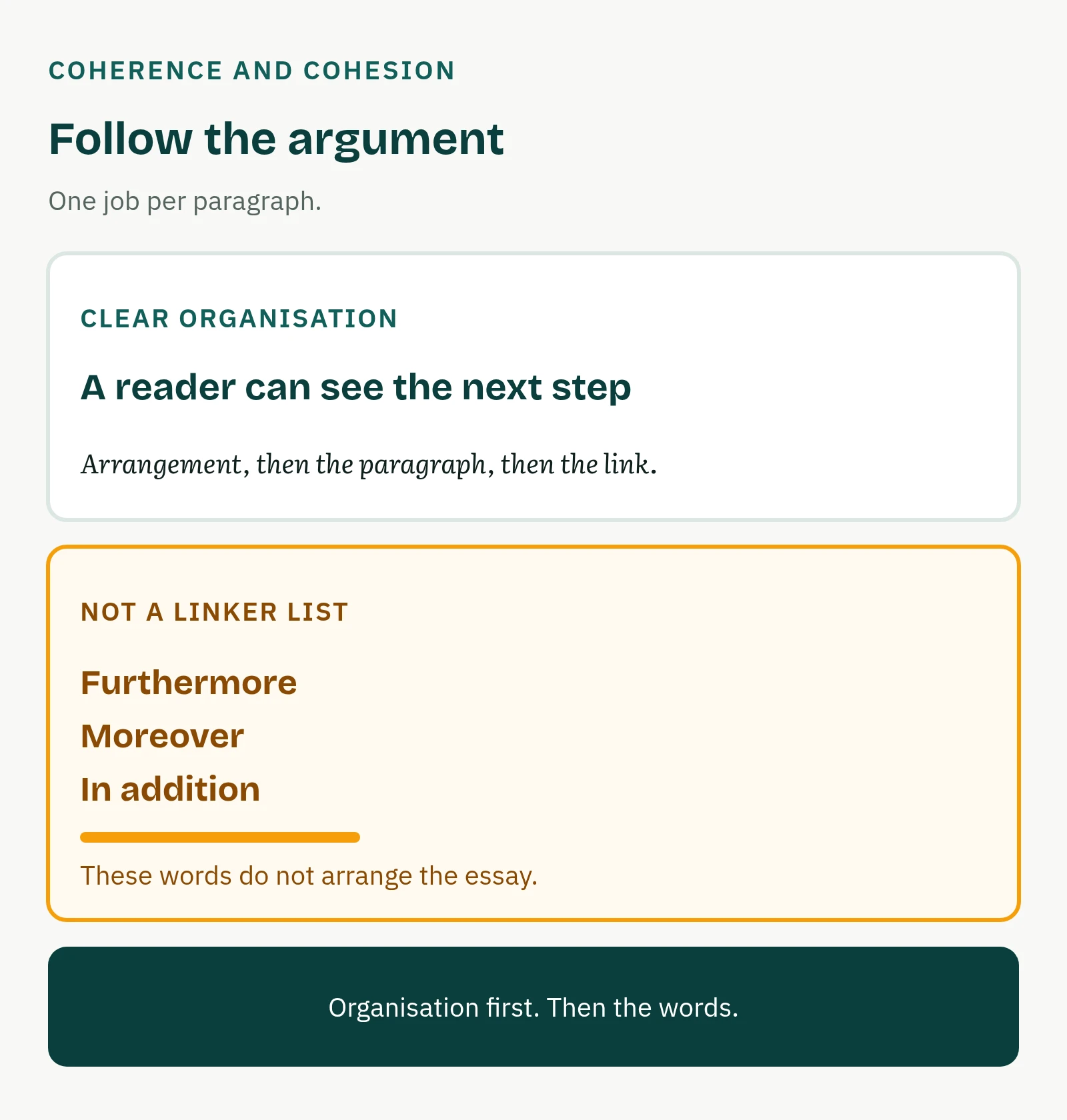
Coherence and Cohesion is whether a reader can follow the argument. It covers the arrangement of the essay, the job of each paragraph, the way one sentence leads into the next, and whether a word such as this points at a noun you can find. It is not a list of linking words.
A linking word is one part of the criterion. It names a relationship, and only after you know the relationship. The four jobs those words do are in Linking words for IELTS Writing Task 2. This article is the rest of the criterion: organisation, paragraphing, logical progression, and referencing.
Task 2 has four criteria, equally weighted: Task Response, Coherence and Cohesion, Lexical Resource, and Grammatical Range and Accuracy. This article stays with Coherence and Cohesion. The short explainer of all four is IELTS Writing band descriptors. Task 1 charts and General Training letters are a different task.
What Coherence and Cohesion is checking
From the public criteria, in our words: the writing is arranged so a reader can follow; ideas progress; paragraphs are used logically; sentences connect; reference words point at something clear. The band tables also flag mechanical links, paragraphing that is not logical, and a this that the reader has to guess.
The Band 6 line, in our words, is an essay that progresses overall. Links can still be mechanical. Paragraphing is not always logical. A pronoun can be unclear.
The Band 7 line is different. Organisation is clear and logical throughout. Each paragraph has one clear central topic. A range of cohesive devices is used appropriately, and linking may still be over-used or under-used. On that public line, the reader does not have to stop and repair the order. A connector on every sentence is not required. Furthermore on a turn is the mechanical link the Band 6 line still allows.
The band lines are in the Writing Band Descriptors PDF. The four names are in the key assessment criteria PDF. Read those files for the official wording. The sentences on this page are ours.
One test, before you hunt for a better connector. Could a reader who has not seen your outline say what this essay decides, and what each paragraph is for? Task Response asks whether you answered. This criterion asks whether the answer can be followed.
Progression the reader can follow
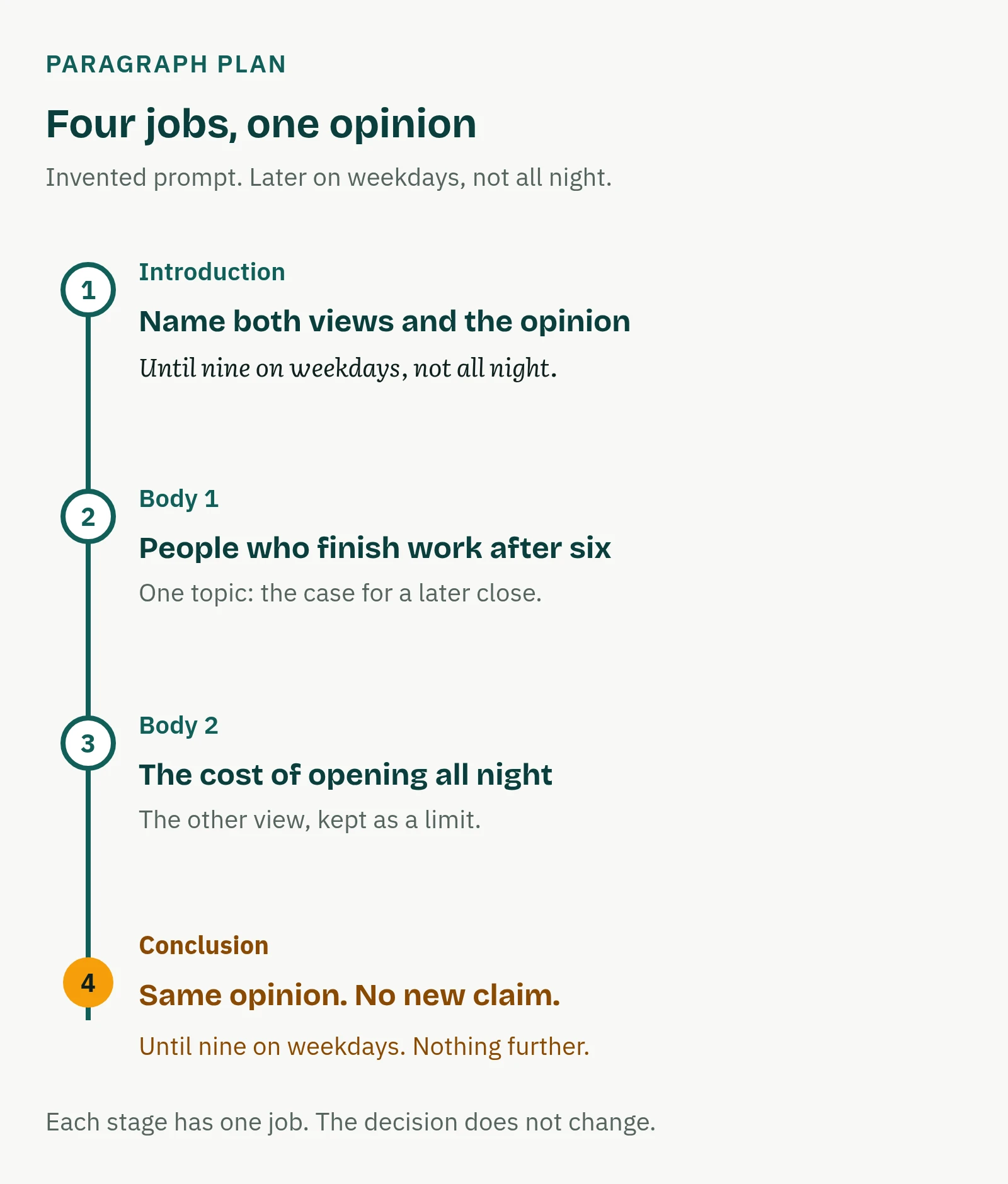
Progression is the order of the whole essay. The reader meets the decision early, sees each part developed, and meets the same decision at the end. An introduction, two body paragraphs, and a conclusion is a study method. It makes the logical organisation visible.
The introduction names the question and the position. Each body paragraph takes one part of that position. The conclusion restates it and adds no new claim. A new reason in the last lines was never developed.
The outline is the paragraph plan beside the essay, not the essay. Write the position as one sentence, then a job for each paragraph, before the first sentence of the body. How to plan an IELTS Writing Task 2 essay is the method. Which jobs you need depends on the instruction: the question types guides name them. Subject practice sits on Task 2 topics. Without those jobs, the next idea that arrives becomes the paragraph. That is how a library essay ends on housing.
Example. An original prompt, invented for this article, not an official question:
Some people think public libraries should stay open later on weekday evenings. Others think the current closing time is enough. Discuss both views and give your own opinion.
The position is also invented. Stay open until nine on weekdays, not all night. The current close is too early for people who finish after six, and the cost of going further is why the essay keeps a limit.
This is the spine of the essay, not a full essay. Each line is a paragraph job.
- Introduction: Name both views and the nine o'clock opinion.
- Body 1: People who finish work after six. One topic, the case for a later close.
- Body 2: The cost of staying open all night. The limit answers that view, and the opinion stays.
- Conclusion: Until nine on weekdays, not all night. No new reason.
A jumpy spine on the same prompt. Invented for this article:
- Introduction: Libraries are important in today's modern world. No opinion.
- Body 1: Evening hours, then the price of housing.
- Body 2: Digital books, then staff wages, then parks.
- Conclusion: Cities should also build more homes.
The introduction never decides. The conclusion then decides something the bodies did not develop, so the route cannot be followed. Answering the question itself is Task Response in IELTS Task 2.
One job per paragraph
A paragraph has one central topic. In our words, the Band 7 line asks for a clear centre, with the sentences developing that centre. At Band 6 the essay can still progress overall while a paragraph changes subject in the middle.
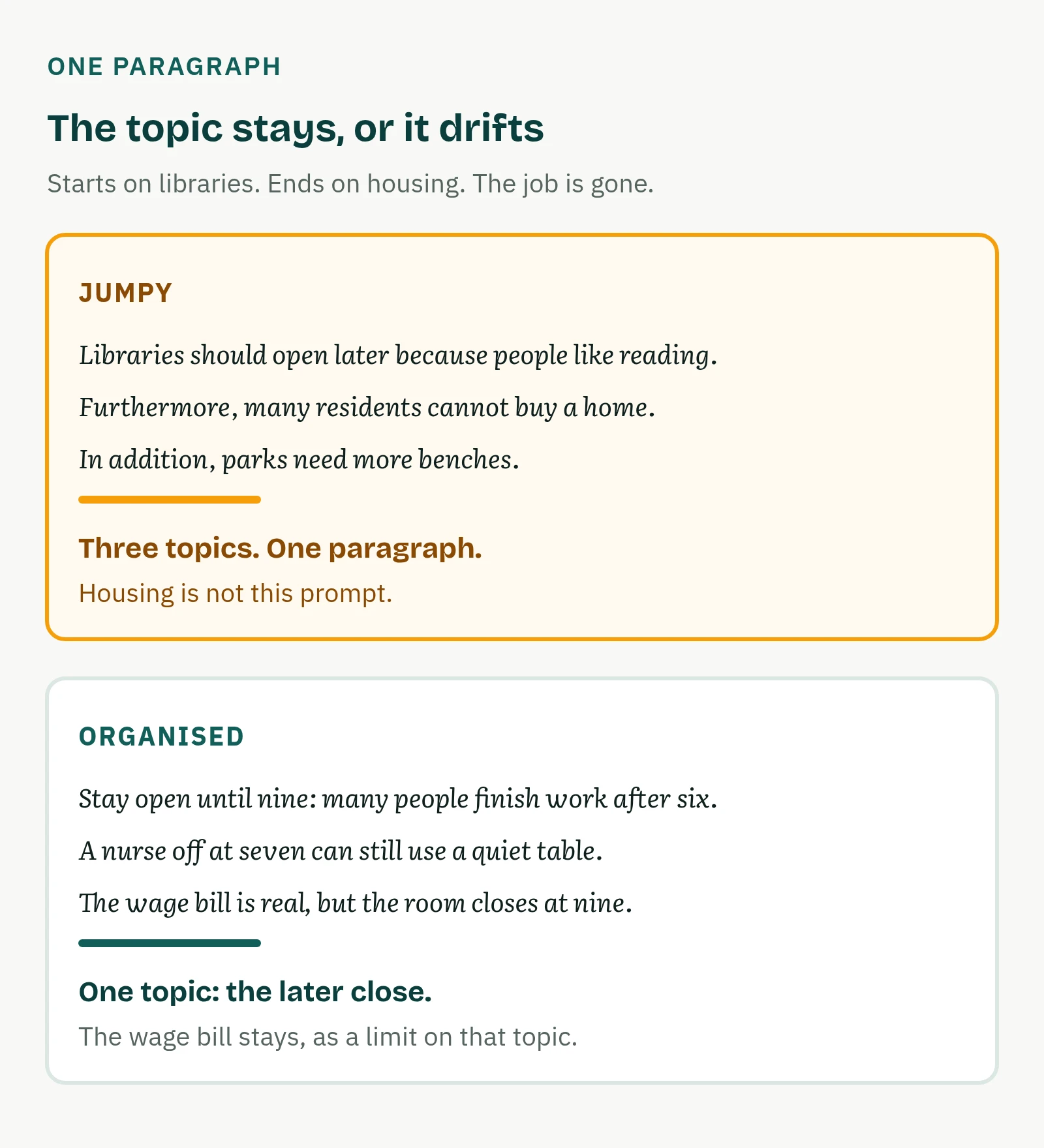
Invented for this article. This paragraph was given one job: the case for a later weekday close.
Libraries should open later because people like reading. Furthermore, many residents cannot buy a home. In addition, parks need more benches.
The first sentence is about libraries, and it is too thin to carry a paragraph. Housing does not show why a library should close at nine rather than at six. Parks are a third topic. A paragraph that starts on libraries and ends on housing has lost its job. Those last sentences could move to another question without a changed word.
Cut them. If housing is the essay you meant to write, put it in another outline. A new linker will not turn rent into a point about opening hours. When the next sentence needs a new topic, start a new paragraph or delete it.
The same hour, kept on one job. Invented for this article:
Libraries should stay open until nine because many people finish work after six. A nurse who leaves a shift at seven can still use a quiet table. A later wage bill is a real cost, but the room can close at nine, so the extra pay is one hour, not the whole night.
The topic is the later close. The nurse is a case of people who finish late. The wage bill is a cost of those hours, so it can stay. Housing does not arrive.
Body 2 is a different job: the cost of going past nine. Staff lock up, and the room is empty after ten. The other view is a limit there, not a new opinion. Wages that end on bus routes are the same leak.
Reference words that point at something
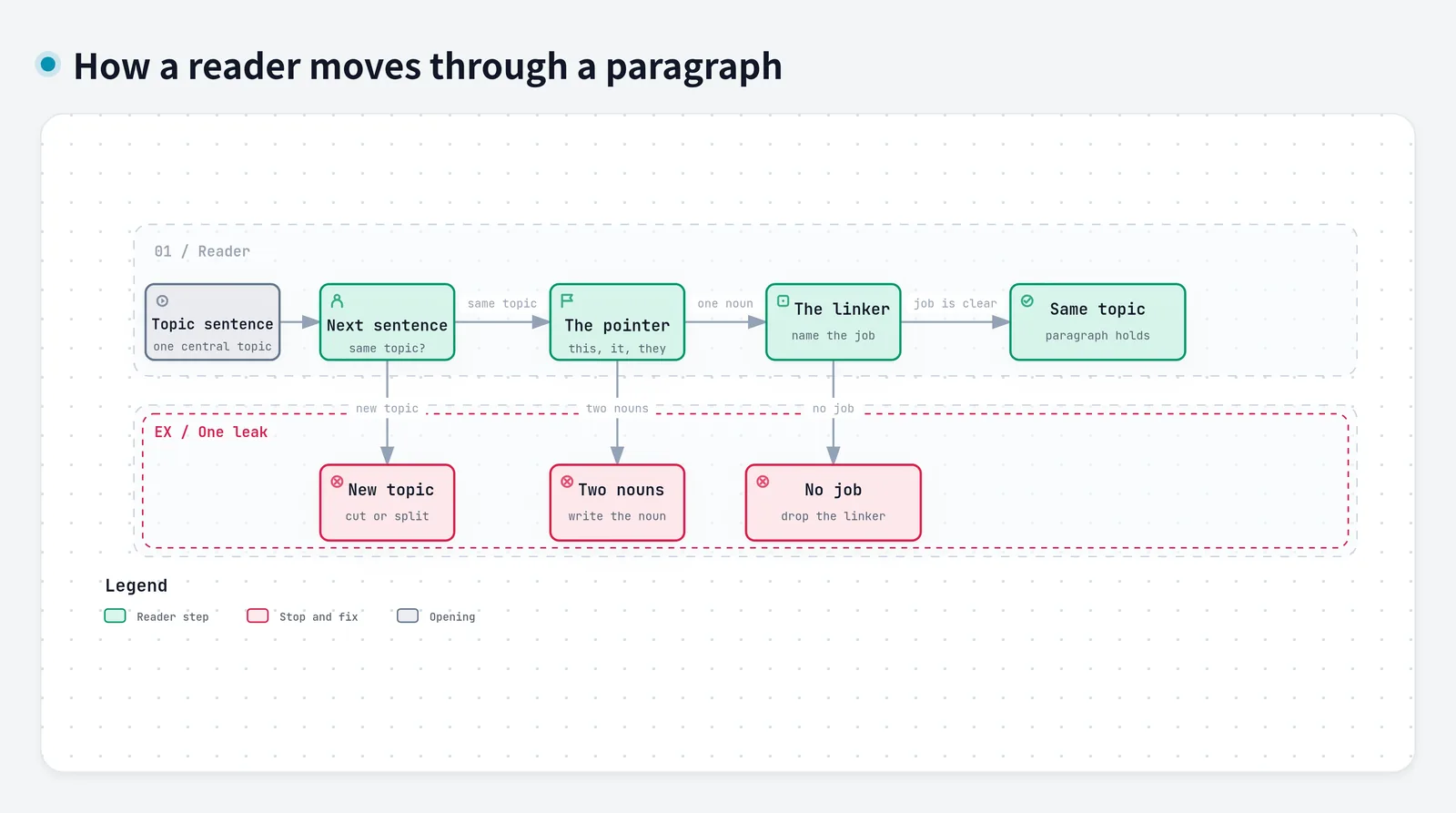
Reference words point backwards: this, these, it, such, they. They save a repeat. They fail when the reader cannot find one noun. In our words, the Band 6 line includes reference that is unclear. Do not delete every pronoun. Leave one noun in reach.
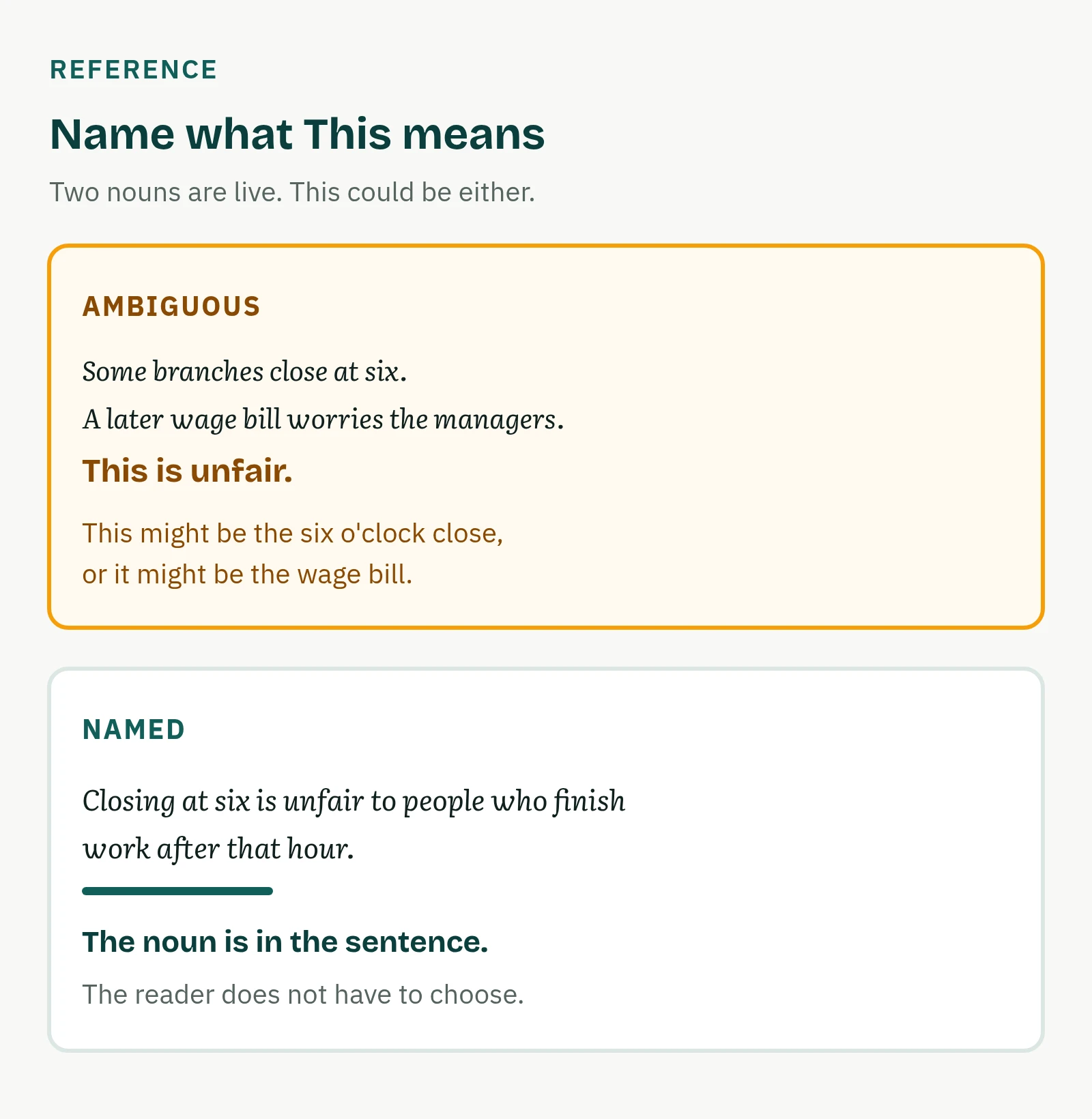
Invented for this article. Two ideas are live, then a pointer:
Some branches close at six. A later wage bill worries the managers. This is unfair.
This might mean the six o'clock close. It might mean the wage bill. Both nouns are still active, and the sentence does not choose. The grammar is fine. The reader guesses.
Name the noun:
Closing at six is unfair to people who finish work after that hour.
The claim is now about the closing time. If the unfair thing was the wage bill, say so: "That wage bill is a problem only if the building stays open all night." "This cost" works when the last sentence named one cost. The moment a second noun is still active, name the one you mean.
These points at a plural you just listed. It points at one thing just named. Such points at a type you just defined. They points at people already on the page. A chain hides the same leak: "The council changed it, but it upset them, and it was expensive." Three targets, one word. Write the hours, the residents, and the wage bill.
Linking is a job, not a list
Cohesive devices show how two sentences relate. Name the relationship, then pick the word. Pick the word first and you often pick furthermore, because it feels safe. A contrast is then written as more of the same.
Four jobs cover most of a Task 2 body: contrast, cause, example, and concession. The words for each job are in Linking words for IELTS Writing Task 2. This article does not rebuild that catalogue.
On the organised paragraph, "because" marks the cause and "but" marks the contrast. "Although" could replace "but". You do not need furthermore in front of either. If you cannot name the relationship, leave the linker out.
Furthermore, moreover, and in addition fail when the next sentence turns, gives a cause, offers a case, or grants a point. That is the mechanical link on the Band 6 line. Under-used linking, which the public Band 7 line still allows, is the nurse sentence with no extra connector. Six openers are not slight. Drop the false furthermore, or split the paragraph that changed topic. That single fix is the same kind of step as in How to move from 6.0 to 6.5 on IELTS Task 2.
Before you submit
Read the essay once for this criterion only. Give it about a minute. This is a study habit, not a test instruction. You are asking whether a stranger can follow the route.
The introduction and the conclusion share one opinion. On this prompt, until nine on weekdays, not all night. Housing in the last lines is a new decision.
Each body paragraph has one topic you can name. People who finish after six. Then the cost of going past nine. If the name needs "and", the paragraph has two jobs.
No paragraph leaves the prompt in the middle. Libraries that become housing are the jump. Cut the stray sentences.
Every this, these, it, and such has one noun. Two live nouns means you write the noun.
Each linker names a job. Contrast, cause, example, or concession. "The next sentence" is not a job. Delete that linker.
The conclusion adds no new claim.
One leak per sitting is enough. The next outline changes the paragraph job, the pointer, or the linker.
A route you can follow
Write the next essay on the Band7 Writing Desk, then read the Grade Report for that sitting. If the comments on Coherence and Cohesion quote a jump, an unclear this, or a mechanical link, put one fix in the next outline.
That report’s figure is an Estimated Band for practice. It is not an official result, and it does not forecast a test day. How the figure is produced is on How Estimated Band works. An essay you have already written can go into the Task 2 checker. If you already have four criterion bands, the IELTS Writing score calculator only does the Writing arithmetic. It does not read the essay.
Follow the argument first. The linking words come after the route is clear.
Related posts
- Grammatical Range and Accuracy in IELTS Task 2
Grammatical Range and Accuracy on Task 2 is varied sentence building, and errors that do not block the reader.
- Lexical Resource in IELTS Task 2
Lexical Resource on Task 2 is precise words, a range the sentence can carry, and topic vocabulary that belongs.
- Linking words for IELTS Writing Task 2
Linking words help Coherence and Cohesion only when they mark a real relationship in the essay.
Browse every post on the Blog, or read the FAQ on Estimated Bands.
Write on the Writing Desk
Free accounts get 2 Grade Reports every calendar month, with Coach tools included.