Grammatical Range and Accuracy in IELTS Task 2
You can write a longer sentence and still say one thing three times. The claim needed a short line. You opened every sentence with Although. Grammatical Range and Accuracy still fails, because the forms are the same form.
Grammatical Range and Accuracy is how sentences are built, and how often grammar mistakes get in the way of meaning. It covers whether simple and complex forms both appear, whether those complex forms are actually different, and whether an error forces the reader to guess. It is not a longer list of complicated structures for their own sake.
Range earns its place only when the sentence carries the claim. Stacking subordinators is not the criterion. This article is variety, and errors the reader can still repair.
Task 2 has four criteria, equally weighted: Task Response, Coherence and Cohesion, Lexical Resource, and Grammatical Range and Accuracy. This article stays with Grammatical Range and Accuracy. The four are named together on IELTS Writing band descriptors. Charts and General Training letters are marked as another task.
What Grammatical Range and Accuracy is checking
From the public criteria, in our words: the writing uses a range of sentence structures; the complex sentences are not all one pattern; errors in grammar and punctuation do not stop the reader.
The Band 6 line, in our words, mixes simple and complex sentences. Errors in grammar and punctuation rarely block meaning. The reader can repair the slip and keep going.
The Band 7 line is different. There is a variety of complex structures. Frequent sentences are error-free. Grammar and punctuation stay under control, and a few errors can remain. The public Band 6 line asks for a mix of simple and complex forms. It does not ask for that variety. The same opener on every sentence has not shown it.
Read the Writing Band Descriptors PDF for the band lines, and the key assessment criteria PDF for the four names. What follows is our paraphrase.
One test, before you hunt for a longer structure. Does the longer sentence add the support, or only repeat the claim? How to move from 6.0 to 6.5 on IELTS Task 2 names that pair: at 6, simple and complex mixed, errors rarely block meaning; at 7, varied complex forms, many sentences error-free. Coherence and Cohesion in IELTS Task 2 asks whether the reader can follow. Lexical Resource in IELTS Task 2 asks whether the words say what you decided. This criterion asks whether the sentences can carry that decision.
Simple and complex both earn their place
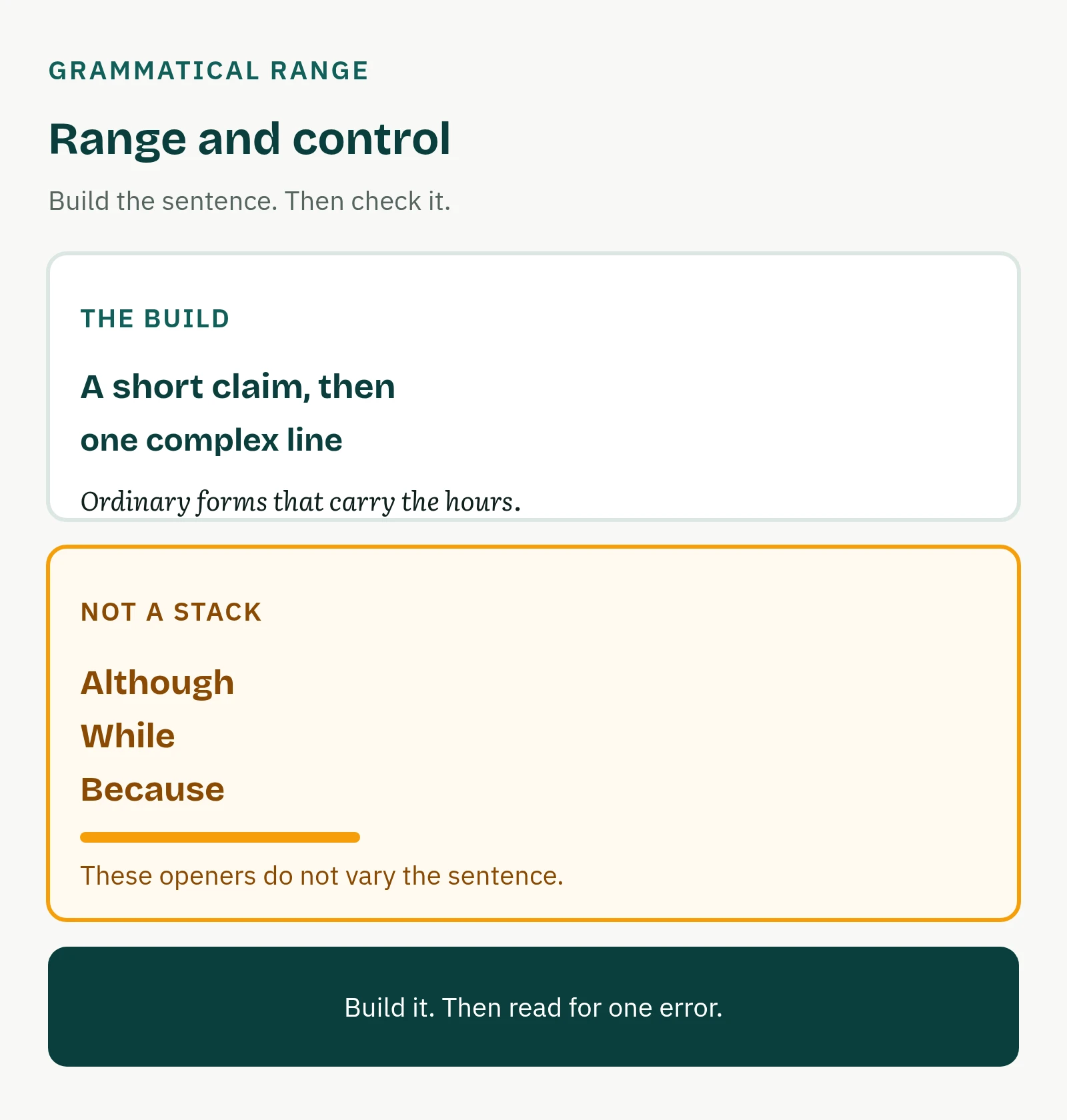
A clear short sentence states the claim. A complex sentence carries the support: who is affected, and which fact belongs to this prompt. Both belong. A paragraph of only short sentences is a list. A paragraph of only long sentences hides the claim.
The usual leak is three short sentences that each hold one fact, and never join them. The reader can follow. The range is thin. The fix is not to glue the lines together with Although. The fix is one controlled sentence for the support, and a short line that still says the decision.
Example. An original prompt, invented for this article, not an official question. More practice, grouped by subject, is on Task 2 topics.
Some people think public libraries should stay open later on weekday evenings. Others think the current closing time is enough. Discuss both views and give your own opinion.
That discuss-both shape is one of the Task 2 question types. The invented position, the same one as in Coherence and Cohesion in IELTS Task 2, is to stay open until nine on weekdays, not all night. Here the job is how the sentences are built, not whether the paragraphs are in order.
Before. Three short sentences. Invented for this article:
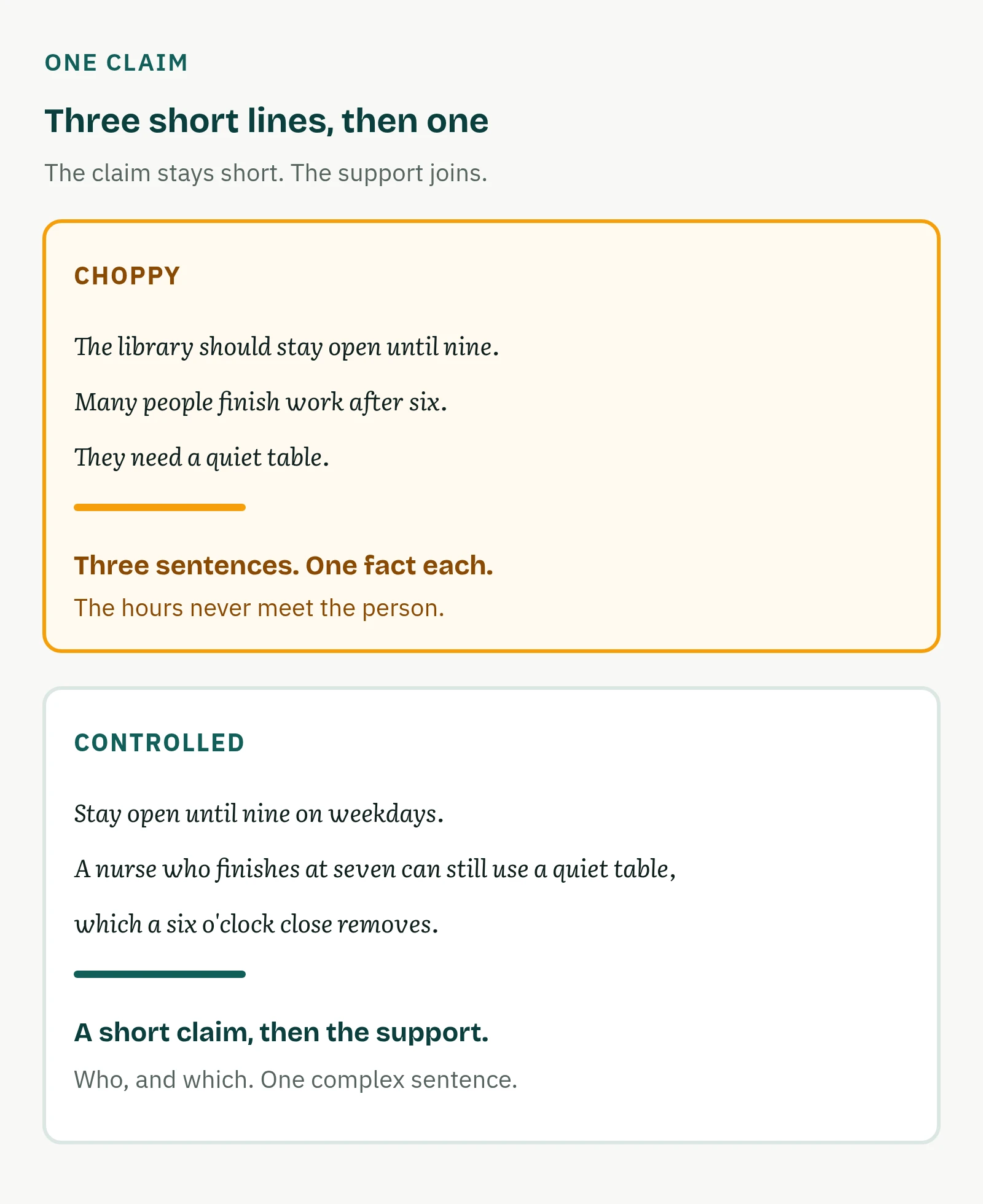
The library should stay open until nine. Many people finish work after six. They need a quiet table.
Each line is clear. None joins the hours to the person. The range is the leak.
A false join does not repair it. Invented for this article:
Although the library should stay open until nine, many people finish work after six, and they need a quiet table.
Although claims a concession, and there is none. The hours and the table are the same point. A linking word names a relationship, in Linking words for IELTS Writing Task 2. It does not, by itself, make a controlled complex sentence.
After. One short claim, then the support. Invented for this article:
Stay open until nine on weekdays. A nurse who finishes at seven can still use a quiet table, which a six o'clock close removes.
The first sentence is the claim. It is simple on purpose. The second does the work the three short lines left undone. "Who finishes at seven" names the person. "Which a six o'clock close removes" names what the current hours take away. One complex sentence, two pieces of support, and the claim stays easy to find.
Both earn their place. Put the claim in the outline first, which is How to plan an IELTS Writing Task 2 essay. The sentence shape follows that job.
Variety, not the same complex form again
Range is not the same complex form repeated. A paragraph can look busy and still use one pattern: a subordinator, a comma, a main clause, again and again. Although, While, and Because are useful. They are not three kinds of sentence when every line opens the same way.
Same shape. Invented for this article, on the same prompt:
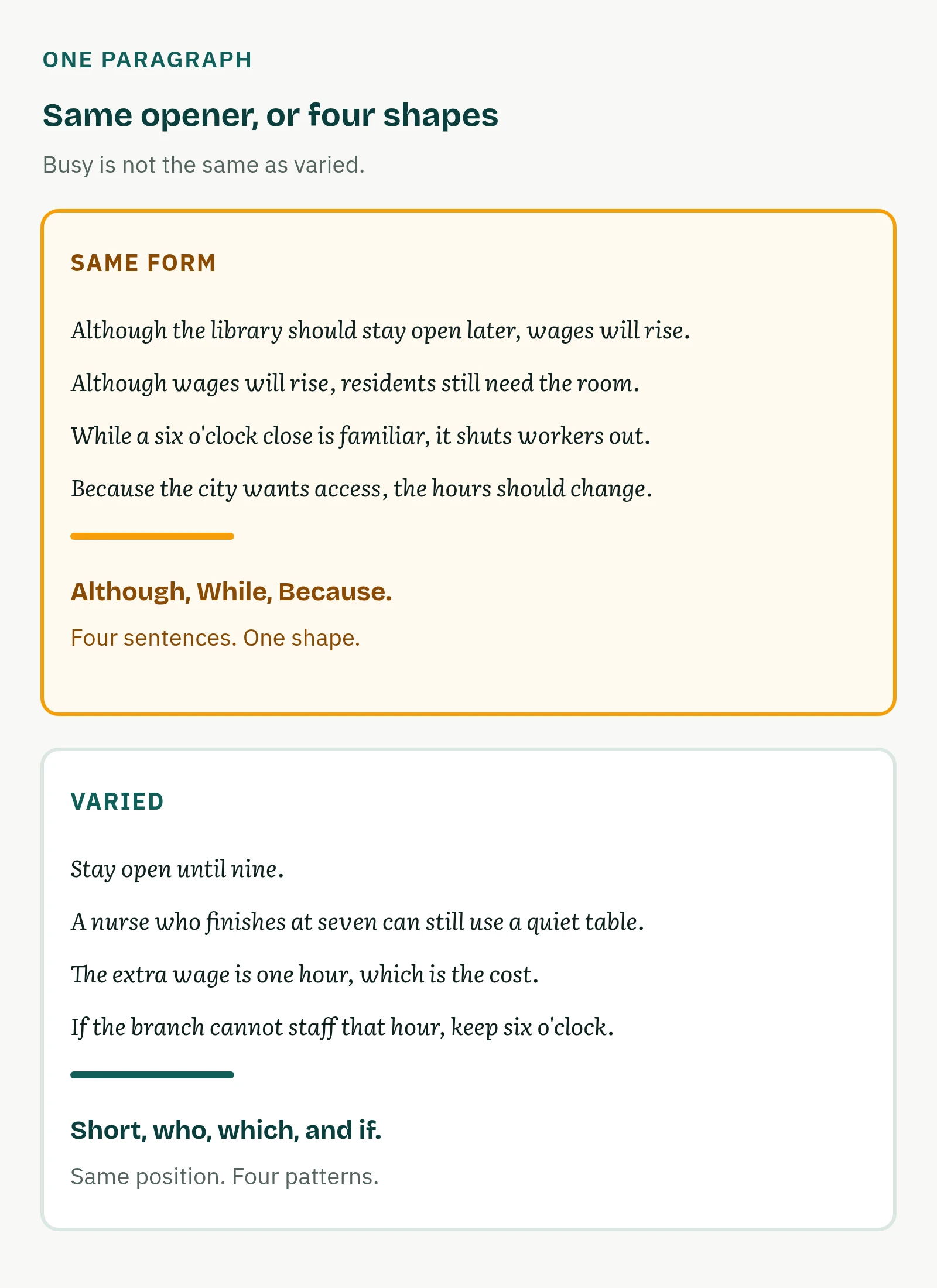
Although the library should stay open later, wages will rise. Although wages will rise, residents still need the room. While a six o'clock close is familiar, it shuts out shift workers. Because the city wants access, the hours should change.
Four sentences. Four openers from the same family. "Although" on the wage line pretends the wage is a concession. The wage is the cost. "Because" on the last line is a real cause, buried under three false contrasts. Busy is not varied.
The varied paragraph. Invented for this article:
Stay open until nine. A nurse who finishes at seven can still use a quiet table. The extra wage is one hour, which is the cost of that access. If the branch cannot staff that hour, keep the six o'clock close and say so.
Four patterns. A short claim. A relative clause with who. A which-clause that names the cost. A conditional that states the limit: the other view, that six o'clock is enough, belongs in the if. The position has not changed. The forms have. That is the Band 7 line on variety, in our words.
You do not need a new structure in every sentence. You need more than one, and the reader should not unpack three clauses to find one fact. If every line could swap its first word for Although and still look the same, it is one form. Change one line on this pass. The which-clause is ordinary English. If the clause adds no fact, cut it.
The first line stays simple on purpose. Variety is not a ban on a short sentence. That line is the claim. The next lines are three different shapes. One change in that paragraph is enough.
Errors that the reader can repair
Accuracy is whether a grammar mistake gets in the way. In our words, the Band 6 line allows errors that rarely block communication. The Band 7 line still allows a few errors. The difference is whether the reader can repair the sentence without guessing the claim.
One leak the reader can still repair. Invented for this article:
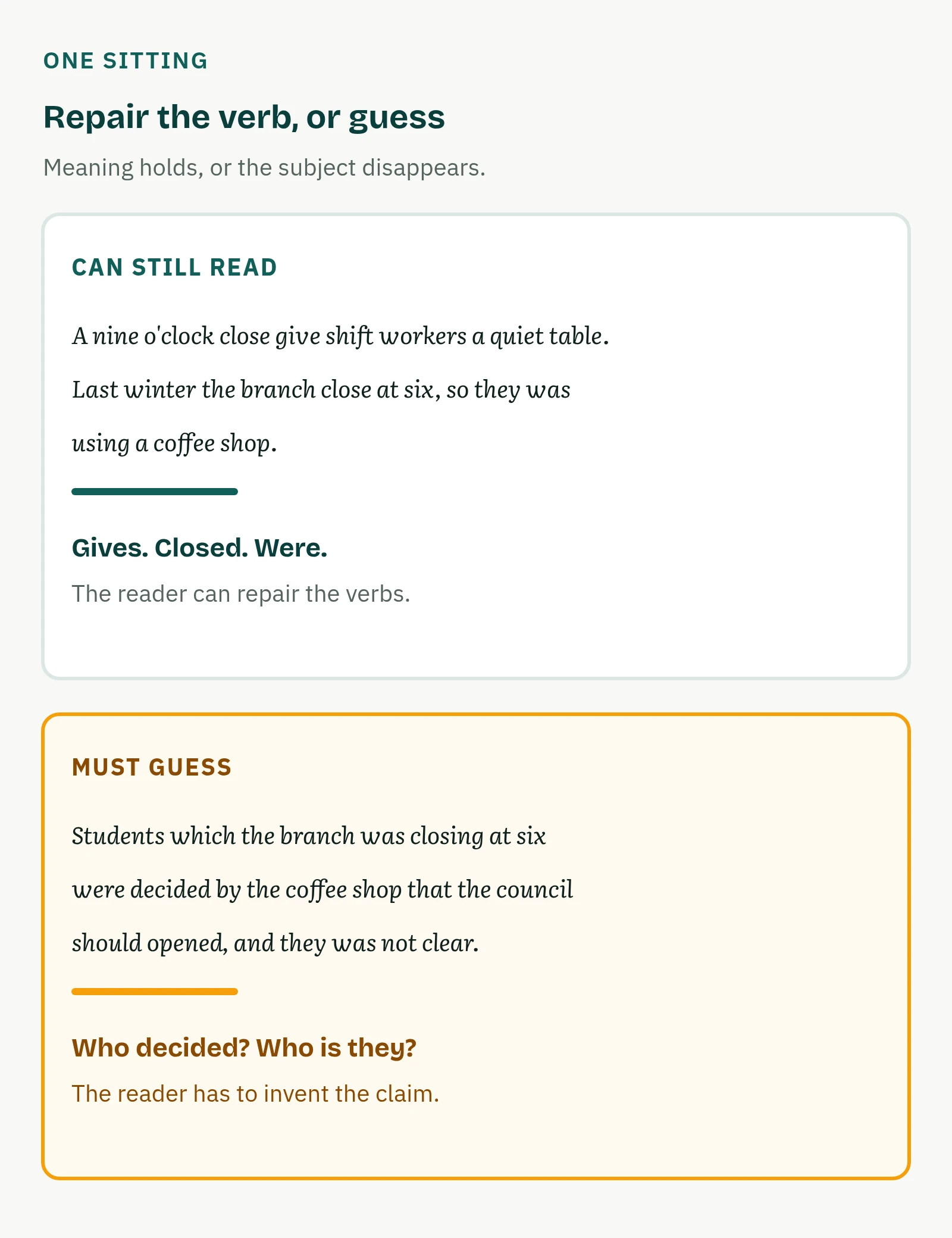
A nine o'clock close give shift workers a quiet table. Last winter the branch close at six, so they was using a coffee shop.
Three slips, and the meaning holds. "Give" should be "gives". Last winter needs "closed". "They was" should be "they were". The reader still sees a later close, a six o'clock shut, and a coffee shop. Communication is not blocked. The forms are still wrong. Errors that rarely block meaning are the public Band 6 line on accuracy. These slips illustrate that line. They do not, by themselves, set a band.
The clean forms. Invented for this article:
A nine o'clock close gives shift workers a quiet table. Last winter the branch closed at six, so they were using a coffee shop.
"Gives" matches the subject. "Closed" keeps last winter in the past. "Were" matches "they". You need the verb that belongs, not a new paragraph. An article is the same class of slip. "A quiet table" is any free seat. Drop "a" and the reader still sees the room. Put it back when you can hear it.
A denser slip forces a guess. Invented for this article:
Students which the branch was closing at six were decided by the coffee shop that the council should opened, and they was not clear.
"Which" tries to point at people, and never says who does what. "Were decided by the coffee shop" makes the shop the decider, or the students the thing decided. Neither is a claim about hours. "Should opened" mixes a modal with a past form. "They" might be the students, the hours, or the council. The reader can invent a meaning and cannot recover yours. Name one subject, one verb, and one time. Do not bury it under another Although.
Frequent error-free sentences are the public Band 7 line, in our words, along with control of grammar and punctuation and only a few errors. It is not zero errors. Most lines should not need a repair. One sentence can. Fix the one you can see, then stop. Although on every line is a range problem. One "give" for "gives" is an accuracy problem. A missing full stop is the same accuracy pass. They are not the same sitting as a rewrite of the position.
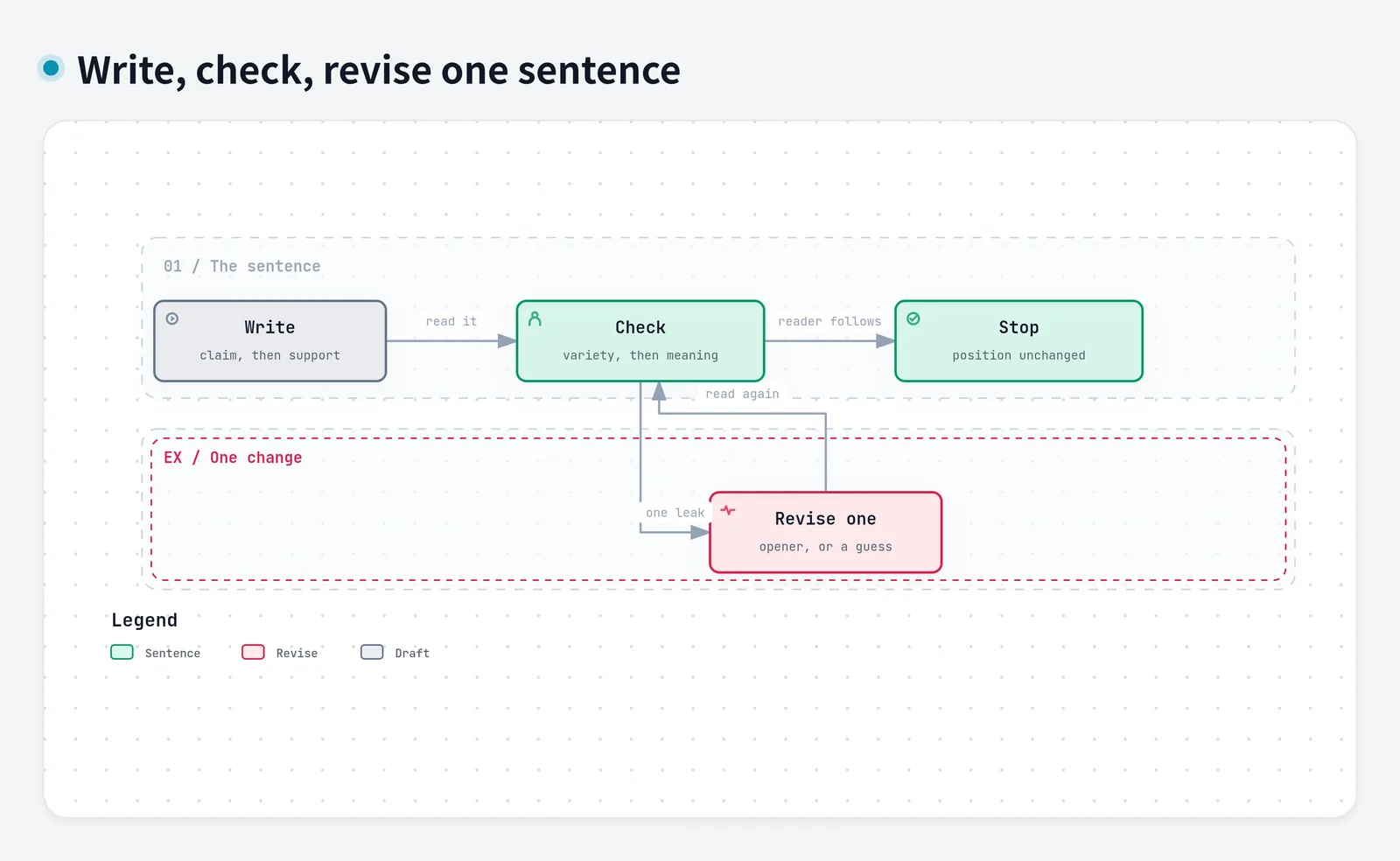
Before you submit
Read the essay once for this criterion only. Use about a minute. The exam does not require this pass.
One short sentence states the claim. On this prompt, "Stay open until nine on weekdays." If the claim only appears inside a long Although-clause, lift it out.
The next sentence carries the support. "A nurse who finishes at seven" is support. A second claim is not.
The complex forms are not all the same. If Although, While, or Because opens every sentence, change one into a who, a which, or an if.
One error you can see. Agreement: give where the subject needs gives. An article you know you drop. A tense that shifts: close where you needed closed. A relative that does not point. Correct that one.
If you have to guess the subject, rewrite that sentence. Name the council, or the branch, or the nurse. Then stop.
One leak per sitting is enough. The next outline changes the sentence, not the position. The position is Task Response in IELTS Task 2. Paragraph order is Coherence and Cohesion. The words are Lexical Resource. This criterion is the build, and whether the reader can trust it.
Sentences that carry the claim
Take the next essay to the Band7 Writing Desk and read the Grade Report afterwards. If Grammatical Range and Accuracy quotes a repeated opener, a tense that shifts, punctuation that breaks the sentence, or a line the reader had to guess, change one sentence in the next outline.
Treat that Estimated Band as practice feedback. It is not the Writing band an exam would report, and it is not a forecast. How Estimated Band works is the method. A finished essay can be pasted into the Task 2 checker. Four criterion bands you already have can go into the IELTS Writing score calculator, which only combines bands you type in.
Build the sentence so it carries the claim. Then check the one error you can see.
Related posts
- Lexical Resource in IELTS Task 2
Lexical Resource on Task 2 is precise words, a range the sentence can carry, and topic vocabulary that belongs.
- Linking words for IELTS Writing Task 2
Linking words help Coherence and Cohesion only when they mark a real relationship in the essay.
- What to expect from an AI IELTS Task 2 practice checker
What an AI IELTS Task 2 practice checker can honestly tell you, what it cannot, and how to use its feedback between timed essays.
Browse every post on the Blog, or read the FAQ on Estimated Bands.
Write on the Writing Desk
Free accounts get 2 Grade Reports every calendar month, with Coach tools included.