Lexical Resource in IELTS Task 2
You can learn a longer word and still say the wrong thing. The sentence needed a plain claim. You wrote a rarer adjective. Lexical Resource still fails, because the word does not mean what you decided.
Lexical Resource is the words on the page. It covers how precise they are, whether the range fits the sentence that has to carry it, whether topic vocabulary belongs there, and whether spelling or word formation gets in the way. It is not a memorised list of Band 7 words.
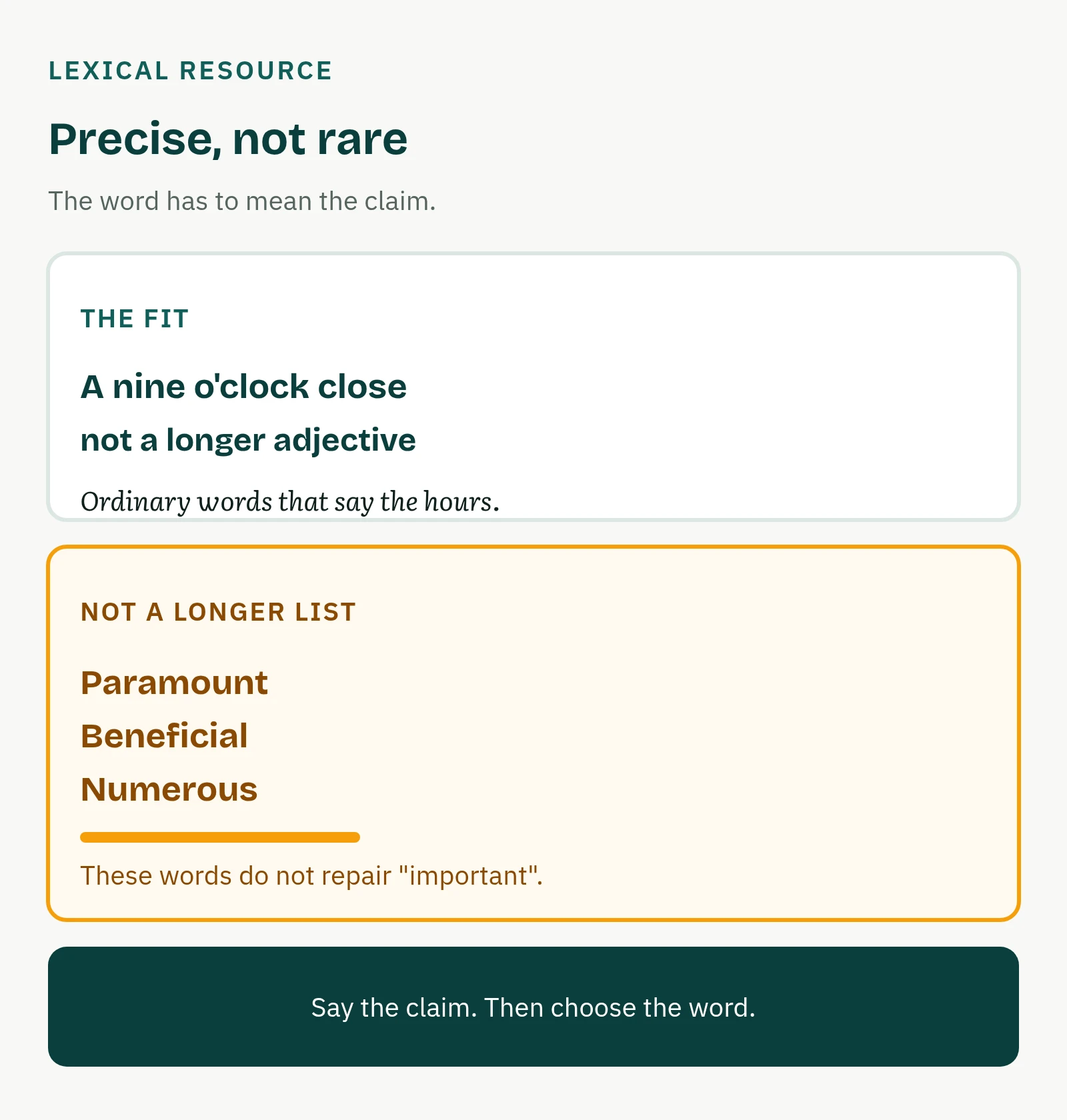
A rare synonym earns its place only when it means the claim. Swapping "important" for a longer adjective is not the criterion. This article is precision, collocation, topic words that belong, and form.
Task 2 has four criteria, equally weighted: Task Response, Coherence and Cohesion, Lexical Resource, and Grammatical Range and Accuracy. This article stays with Lexical Resource. All four are sketched on IELTS Writing band descriptors. A chart report and a General Training letter are outside this page.
What Lexical Resource is checking
From the public criteria, in our words: the writing uses a range of vocabulary; the words are precise enough for the claim; less common items show some awareness of style and of words that sit together; spelling and word formation do not stop the reader.
The Band 6 line, in our words, is an adequate range. Less common words are attempted, and some of those choices are inaccurate. Spelling or word-formation errors do not block communication.
The Band 7 line is different. There is some flexibility and precision. There is some awareness of style, and of words that sit together. An occasional error of choice, spelling, or form can remain. On that public line, the reader does not have to translate your word back into the plain one you meant. "Paramount", when the claim still means "important", is the inaccurate less-common choice that Band 6 describes. It is an illustration, not a scoring rule.
Official wording is in the Writing Band Descriptors PDF. The key assessment criteria PDF names the four criteria. This page paraphrases those files. It does not replace them.
One test, before you hunt for a longer word. Could a shorter word keep the same claim? If it can, the longer word was not doing work. How to move from 6.0 to 6.5 on IELTS Task 2 names that leak. Coherence and Cohesion in IELTS Task 2 asks whether the reader can follow. This criterion asks whether the words say what you decided.
Precision beats rare words
Precision is the fit between the word and the claim. Range is how many precise choices the sentence can carry. A long paragraph can still live on one adjective.
The usual leak is a vague everyday word, repeated: important, good, bad, things, and people, when a concrete noun already exists. The same word for three claims is a thin range. The public Band 6 line asks for a range that is adequate for the task. The fix is the noun the outline already named.
Example. An original prompt, invented for this article, not an official question. More practice, grouped by subject, is on Task 2 topics.
Some people think public libraries should stay open later on weekday evenings. Others think the current closing time is enough. Discuss both views and give your own opinion.
That discuss-both shape is one of the Task 2 question types. The position, shared with Coherence and Cohesion in IELTS Task 2 so the wording can be set beside the paragraph jobs, is to stay open until nine on weekdays, not all night. Here the job is the words inside one of those paragraphs, not the order of the essay.
Before. Invented for this article:
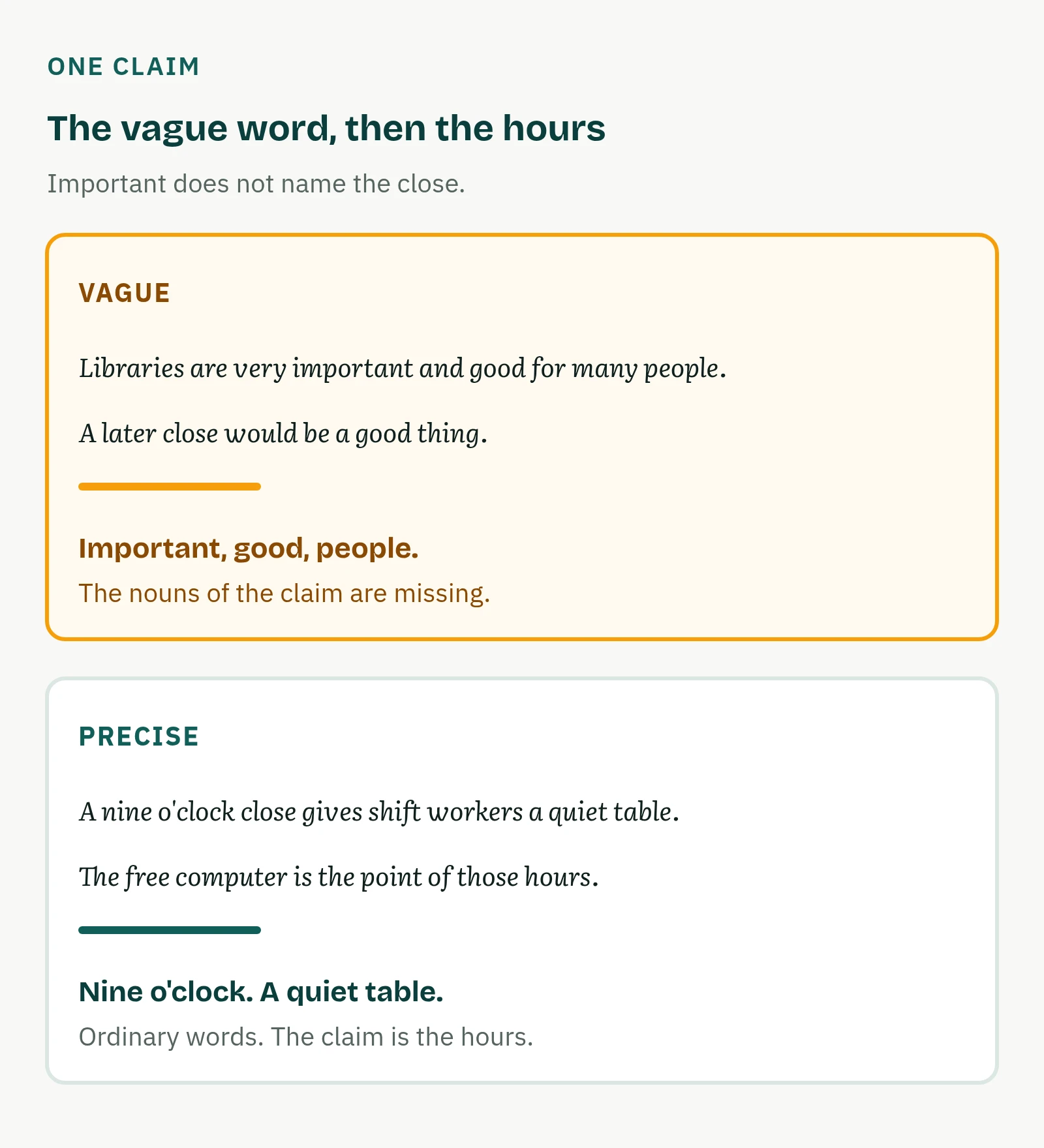
Libraries are very important and good for many people. A later close would be a good thing, because things are bad when people cannot use the building.
Every claim is good, bad, or important. "People" stands in for residents who finish after six. "Things" stands in for the closing time. The reader can guess. The words do not say the hours or the room.
A rarer swap does not repair it. Invented for this article:
Libraries are paramount and beneficial for numerous individuals.
"Paramount" means more important than everything beside it. This sentence has not shown that ranking. "Beneficial" still means good. "Individuals" still means people. The claim is the same fog.
After. One vague stretch, replaced with the claim:
A nine o'clock close gives people who finish work after six a quiet table and a free computer.
"Nine o'clock", "quiet table", and "free computer" are ordinary, and they are already the support. "People" can stay, because the next words say which people. "People" alone is vague. If a less common word is wrong, put the plain word back. Those nouns go in the outline first, which is How to plan an IELTS Writing Task 2 essay.
Words that sit together
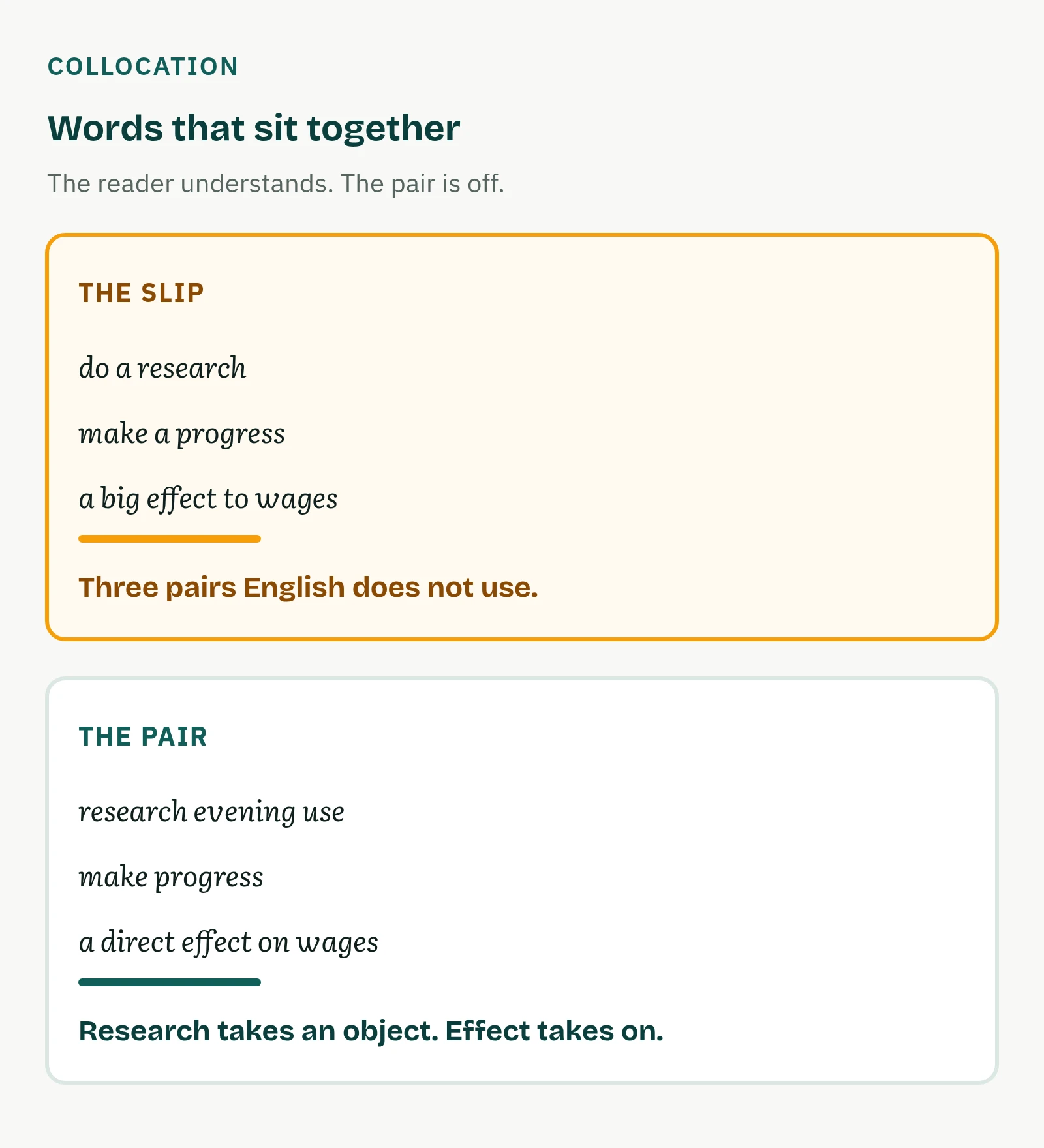
Collocation is which words keep company. English already has the pair. "Do a research", "make a progress", and "strong rain" are the classroom slips. On a Task 2 essay the same habit is "do a research about evening users", or "a big effect to staff wages". The reader still understands. The pair is not the one the language uses.
Invented for this article, on the same prompt:
The council should do a research about evening users and make a progress on the closing time. A later close will have a big effect to staff wages.
Three pairs are off. You research a topic, or you carry out research. You do not "do a research". You make progress, with no "a". An effect is on something, not to something. Rain is heavy, not strong. The same miss.
The natural rewrite. Invented for this article:
The council should research evening use before it changes the closing time. A later close will have a direct effect on staff wages.
"Research" takes "evening use". "Effect" takes "on". "Direct" is ordinary, and it names the wage bill for one extra hour. "Strong effect" can sit. "Big effect to" cannot.
Read the pair aloud. If you would not say "do a research" about a library, it does not belong on the page. Linking words are a different job. They name a relationship between sentences, in Linking words for IELTS Writing Task 2. A correct "however" does not repair "do a research".
Topic vocabulary that belongs in the sentence
Topic vocabulary is what a reader expects on this question: closing time, staff wages, shift, branch, study space. The words belong when they do work. They fail when they arrive as a list you prepared before the prompt.
Dropped in. Invented for this article:
Public libraries promote literacy, digital inclusion, lifelong learning, and social cohesion. Therefore the opening hours should be extended for the community.
None of those nouns says why nine is better than six. "Therefore" pretends the list was a reason. "The community" is "people" again.
The same ideas, earned by the claim. Invented for this article:
A branch that stays open until nine lets a nurse who finishes at seven use a study space. That is the access a six o'clock close removes. The extra wage is one hour, which is the cost of that access.
"Branch", "nine", "nurse", "study space", and "wage" each point at this prompt. "Access" earns its place because the next sentence says what is removed. Delete "literacy" and the argument gets clearer. If the sentence still answers without the topic word, the word was decoration.
That feel for what can sit here is the Band 7 line on style. It is not a display of stored nouns. Answering the question is Task Response in IELTS Task 2. A precise paragraph about housing is still the wrong task.
Form and spelling that do not block the reader
Word formation is the shape of the word: noun, verb, adjective, prefix, ending. Spelling is whether the reader can recover the word. In our words, the Band 6 line allows spelling and word-formation errors that do not block communication. The Band 7 line still allows an occasional error of form. One clear slip, which the reader can repair, is this leak.
Invented for this article:
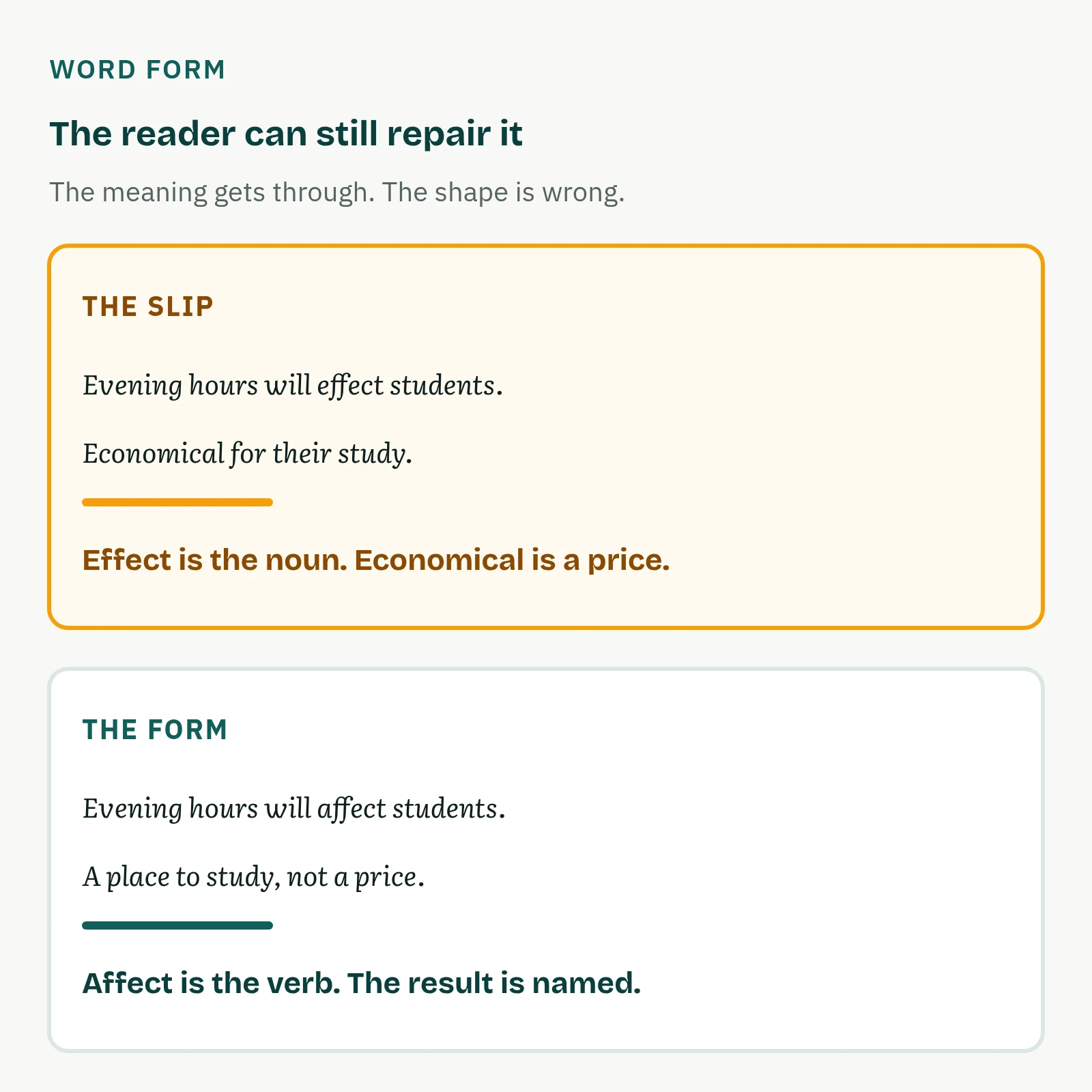
Evening opening hours will effect students who finish class after six. The change is more economical for their study than a six o'clock close.
"Effect" is pressed into service as a verb. The verb is "affect". The reader hears "will change", because the noun "effect" means a result. Communication is not blocked. The form is still wrong. "Economical" means thrifty, or cheap to run. The sentence seems to mean "better for study", which is not a price. If you meant the city's economy, the adjective is "economic". Here the claim is a place to study, so "economical" is the wrong shape.
The clean forms. Invented for this article:
Evening opening hours will affect students who finish class after six. The change gives them a place to study, which a six o'clock close does not.
"Affect" is the verb. The second sentence names the result.
Spelling sits in the same minute. "Seperate" and "neccessary" rarely stop a reader. They still count. Correct the one you know you swap.
Before you submit
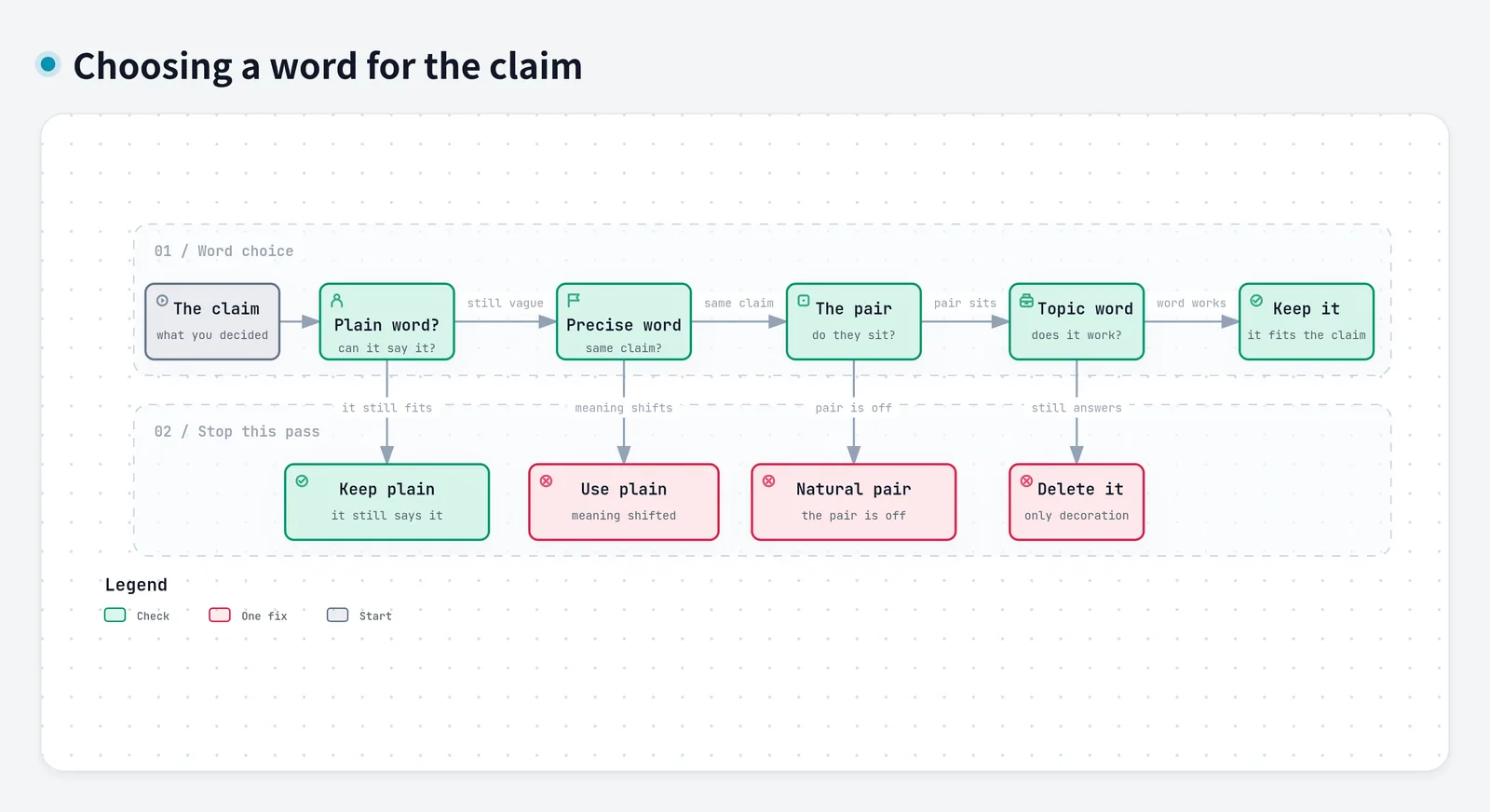
Read the essay once for this criterion only. One minute is enough. Nothing in this pass is an exam rule. You are asking whether the words say the claim.
One vague word you could replace. Important, good, bad, things, or people standing in for a noun you have. On this prompt, "a good thing" becomes "a nine o'clock close". Replace one.
The replacement means the same claim. "Paramount" does not mean "important" unless you have shown that ranking. If you cannot gloss the new word, put the plain word back.
The pairs sit together. Research is not "do a research". Progress is not "make a progress". An effect is on something.
Topic words earn their place. If you can delete "literacy" and the sentence still answers, delete it. Keep "nine o'clock" and "staff wages" when those are the claim.
One form error you can see. "Effect" where you needed "affect". "Economical" where the claim was not about price. Correct that one.
One leak per sitting is enough. The next outline changes the wording, not the position. The position is Task Response. The order of the paragraphs is Coherence and Cohesion. Lexical Resource is the words inside the job you already set.
Words that fit the sentence
Open the Band7 Writing Desk for the next essay, then read that sitting’s Grade Report. If the Lexical Resource comments quote a vague word, a pair that does not sit, or a form the reader had to repair, change one wording in the next outline.
The Estimated Band on that report is practice feedback. It is not an official result, and it is not a forecast. The method is on How Estimated Band works. Paste a finished essay into the Task 2 checker. Bands you already have for the four criteria can be entered in the IELTS Writing score calculator. The calculator does the Writing sum. It never reads the essay.
Say the claim in words that fit. A longer word can wait until it means the same thing.
Related posts
- Linking words for IELTS Writing Task 2
Linking words help Coherence and Cohesion only when they mark a real relationship in the essay.
- What to expect from an AI IELTS Task 2 practice checker
What an AI IELTS Task 2 practice checker can honestly tell you, what it cannot, and how to use its feedback between timed essays.
- How to move from 6.0 to 6.5 on IELTS Task 2
Move an IELTS Task 2 essay from around 6.0 towards 6.5 by lifting one criterion at a time, using the public descriptors for 6 and 7.
Browse every post on the Blog, or read the FAQ on Estimated Bands.
Write on the Writing Desk
Free accounts get 2 Grade Reports every calendar month, with Coach tools included.